Aug 22, 2015

The Wolf Sea Divine Cult Spell List

The list of spells available to each major cult in the Wolf Sea area. Each cult can teach members spells from the Common list, and then has six specialty spells + and an appropriate Otherworld Journey spell.


Full write-ups of the cults will follow at a later date.

Aug 21, 2015

Sorcery Spell Lists in the Wolf Sea

Here's a list of spells that the four sorcery schools in the Wolf Sea teach. The list of spells marked "Common" can be learnt by a wizard in any tradition. Barons of Hell are demons, Drowned Legions are masses of undead warriors and sailors who drowned, Undead Wyrms are self-explanatory, and Tulpa-Shoggoths are creatures made of protoplasmic dream-stuff.


You can also get a sense of the cosmology of the setting. Along with the living world, there's the Afterlife, Hell, and the Dreamworld. The Afterlife is where dead souls go, whether for good or ill. Hell is an alternate world, not where the wicked end up automatically, but rather an alien reality, and the Dreamworld is where the contents of dreams come from and go back to once the dream ends.


Aug 18, 2015

Battle Magic Spell Lists in the Wolf Sea

There are three battle magic skills in campaigns set in the Wolf Sea. Necromancy, taught by ancestor cults, psionics, taught by psionic dojos, and geomancy, taught by geomantic schools. You can learn all three, and they're widespread throughout the continent. Other battle magic spells exist, but as one-offs or specialties you have to search out and learn.

When you create a character, you pick one to start at POW x 3, and the other two start at POW. You can raise them by spending improvement points like any other skill.

Here's the spell list of battle magic spells (taken from Openquest 2):


Aug 15, 2015

Magic and Religion in the Wolf Sea

The small area of the hexcrawl continent I'm focused will be called "The Wolf Sea" just because it sounds kind of cool and so I don't have to keep on calling it "the western bay".

Anyhow, here's a map of how you learn magic in the Wolf Sea and surrounds. Blue squares are common institutions that teach battle magic. Red squares are schools of sorcery, orange squares are religions, and purple squares are shamanic groups. Each type of blue square has its own spell list of battle magic spells, while each religion and sorcery school does as well. Each shamanic school teaches you to manipulate certain kinds of spirits. All this stuff will get covered in the write-ups of each group.

The blue square are the starting positions for PCs on this diagram, unless you start as a priest or a sorcerer, in which case you start on an orange or red square as appropriate. The arrows indicate institutional access. So if you want to say, join the Sailors of the Dream Sea, you'd either better be an initiate of the Void Drowned or Unknowable Sea, or a member of a psionic dojo. The actual transitions can arise organically in game, they don't need specific rules covering them.


Here's a map that's somewhat messy, but covers the various churches operating in the Wolf Sea. It's colour-coded. Different bubbles of the same colour indicate independent church organisations.

Red - The Krovian Imperial Cult
Pink - The Idols of Hell
Orange - The Way of Peace
Yellow - The Divine Architect
Purple - The Ancient Dragons
Blue - The Unknowable Sea
Black - The Void Drowned
White - The Great Mother


From this you can see that the Void Drowned and the Idols of Hell are mostly marginal, except for that big city of devil-worshippers controlling the southern half of Wyvland. The Ancient Dragons are trucking along strong in the hinterlands, but are almost gone in the heavily settled areas except for a rump presence in the westernmost region of Blackwater, while the Unknowable Sea is fading in popularity except amongst port-towns. The Way of Peace is a missionary religion spreading itself over the sea, while the Divine Architect is mostly popular in the cities of Blackwater and Marlech. The Krovian Empire forbids all churches other than its own unified Imperial Cult and the cult of the Great Mother. The Great Mother is popular almost everywhere, but the church is fragmented.

Most of these religions will crop up elsewhere in the campaign setting, as will new ones, while a few will be specific to this area.

The Starting Map for Players

This'll be the starting map for the hexcrawl, more or less. I have a heavily marked up referee-only version with a lot more stuff on it (mostly dense networks of villages and castles too minor to note here, but also all the caves and dungeons). This area is about 1080km x 720km, covering an area about the size of Turkey, or about 20% larger than France, with four major polities and several minor ones at their periphery.


Also, Cole mentioned going down the language rabbit hole. Here's a diagram laying out the connections between languages. Purple language 1, as yet unnamed, is the dominant language in the area, but the Krovian Empire speaks blue language 5 (which will probably be named Krovian), and purple language 2's periphery is that dense forest in the north-east.

Aug 11, 2015

Maps of an Openquest Hexcrawl

I'm thinking my next campaign once Necrocarcerus finishes up will be to run an Openquest sandbox with a lot of hexcrawling. To that end, I've been preparing maps using Hexographer. The setting itself doesn't have a ton of detail. I'm holding off choosing names, feel, etc. for now until I have a numbered list of the various elements (languages, etc.) that I can flesh out. At last count there are 26 living languages, and somewhere around a hundred polities - almost as complex as Europe.

This is the continent it'll be taking place on. This map is using 30km / hex scale:


And this is the starting area, at 5km / hex scale. It's a "child map". This is the player-facing map (though they wouldn't start with it). I'll be filling in the referee-only material separately.


Labels will be forthcoming on both maps once I find a format I'm happy with. I've also got to populate the second map with GM-only locations, and then do some setting writing, both some large scale stuff and some detailed technical writing statting everything up.

Bonus maps!

I uploaded the continental map to Realtimeboard and did some doodling. Here's a sketch of the major polities and their areas of influence.


And this is a map marking out the linguistic boundaries of each region (the colours are meaningless, I just selected them for contrast and visibility):


Aug 3, 2015

Graphing Dungeon Connections

I'm going to show you how to use Realtimeboard to map a dungeon's connections.This is an introductory tutorial to graphing dungeons, rather than a depiction of the finished project.

This'll be useful whether you just want to pointcrawl, or whether you want to map a dungeon and need to figure out the relations between the spaces in it beforehand. This example from my Old Hua Danth dungeon in Necrocarcerus, which I ran using a Dyson Logos map. I'm thinking of distributing the module, which means I'll need to create a new map for it. But the dungeon was written with the connections from this map, so whatever I draw will need to preserve them.

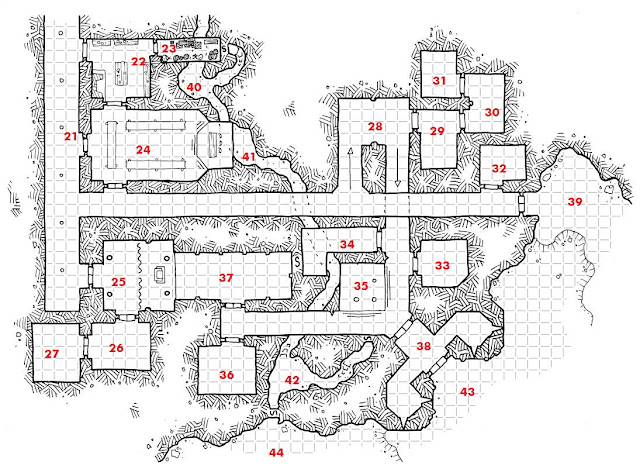
For reference, the original maps I used are these two, which I grabbed off of Dyson's G+ and can't find a link to on Dyson's blog. I added the red numbers myself in MSPaint to key the place back when I ran it a few months ago. 


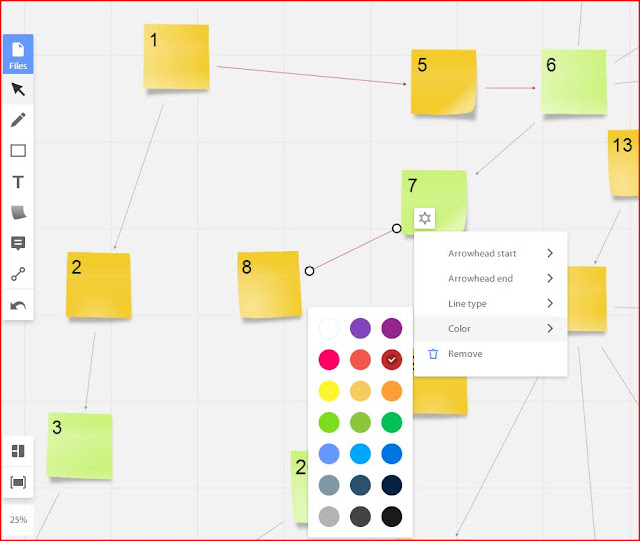
Step 1 is really simple. Use the sticky tool to make a bunch of stickies that are numbered with all the rooms in the dungeon.


Step 2 is to grab the link-arrow tool and start linking them. You click on one sticky, then the other. You don't need to sort your stickies out yet, the tool has no problem with intersections or crossovers.


When you're finished, you should have something that looks like this:


Step 3 is to sort them out. You'll need to do this manually, but basically pull any linear sequence of rooms that doesn't connect to the others into a straight line projecting off the larger mass of stickies, and then shift things around internally so you have as little crossover as possible. You'll end up with something like this.


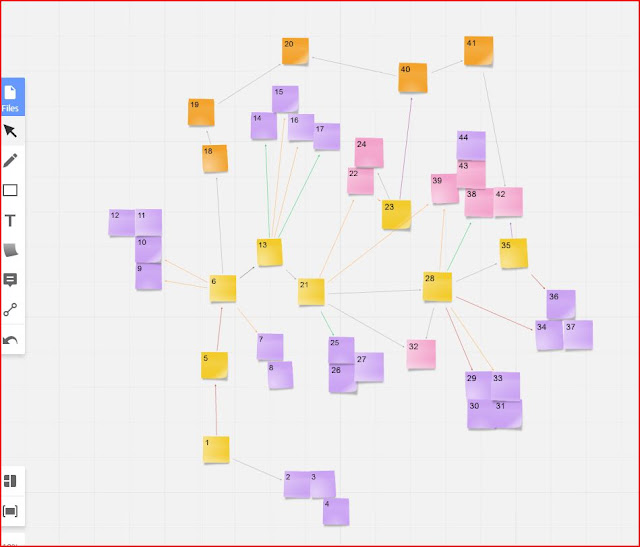
Step 4 is to colour code the stickies and the link-arrows. You can mass select stickies by holding the shift-key, and you can theoretically do the same thing with link arrows, but I find it more difficult. Colour-coding helps visually distinguish the various sections of the dungeon and can convey other useful information to keep in mind.

The key I use for link-arrows is:

Red - Locked door
Orange - Stuck door
Green - Free door
Grey - No door
Purple - Secret door

You could use blue or yellow to indicate other types of connections, like magic barriers or teleporters or whatever.


Here, for the stickies, I used the following colour scheme. Linear paths that could be moved around get shaded purple.The secret path that flows under / between other rooms got shaded orange, since I can squeeze it in. The core rooms whose placement in the dungeon affects the placement of the rest got shaded yellow. Rooms with more than two connections, or rooms that connect to two or more yellow stickies, got shaded pink. 

If you're planning to create pointcrawls for dungeons, you can end at this point, though you might as well fill out the stickies with information about the individual rooms so that it's both map and key at the same time.


What I'm going to do is rotate all the stickies to give them a new orientation, while preserving the relations. This'll help make sure that when I'm drawing the new map, its look will be substantially different than Dyson's, and won't end up unintentionally influenced by his room forms and shapes.


What I suggest doing is generating all the rooms of one type at a time - all the yellows, then all the pinks, then all the purples. Fit the purple linear pathways into solid chunks or lines, and the pink rooms into clusters. I like to get a rough sense of how they're going to fit together here.


Next, I'm going to be using a variation of the "Dellorfano Protocol" to generate room sizes, starting with the purple and pink clusters.
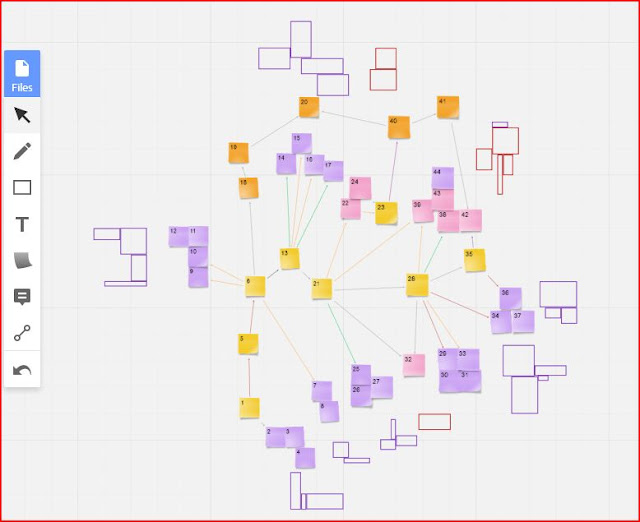

Anything boring, like long one-square thin rooms, I'm going to turn into irregularly shaped rooms.


Next, I draw some larger black blocks representing the yellow stickies. I make sure the black blocks connect the same way the yellow stickies do to one another. I move the existing dungeon blocks over and attach them to the black block representing the appropriate yellow sticky. Red blocks, representing the pink connectors, will go on the connections between blocks, while purple ones will attach to a single block (most of the time). I try to make the black blocks large enough to attach a few coloured blocks, but not so large you can't set a sense of space. I also move purple and red blocks as close together as I can. You can number things in case it starts to get confusing.


From that point, you begin shuffling things around to compress them. The size and shape of the black blocks is totally flexible, so long as the attachment points are retained. You can also recategorise blocks - I shifted the colours and priorites of some of the blocks around as it became more apparent where they should fit. I also finished off by sketching in (admittedly crudely) the outline of the secret rooms.

From here, I'm ready to begin a freehand sketch, or I could keep fiddling with it. When transferring it to freehand, I'd add details to make it less square-looking with furnishings, cave-in rubble, altering the shape of some of the rooms further to fill in white space or more closely resemble their keyed function, etc. You can make the dungeon feel particularly convoluted by transforming the large black blocks into winding corridors with lots of dead ends, switchbacks, etc.