Showing posts with label Things I Wrote. Show all posts

Feb 20, 2022

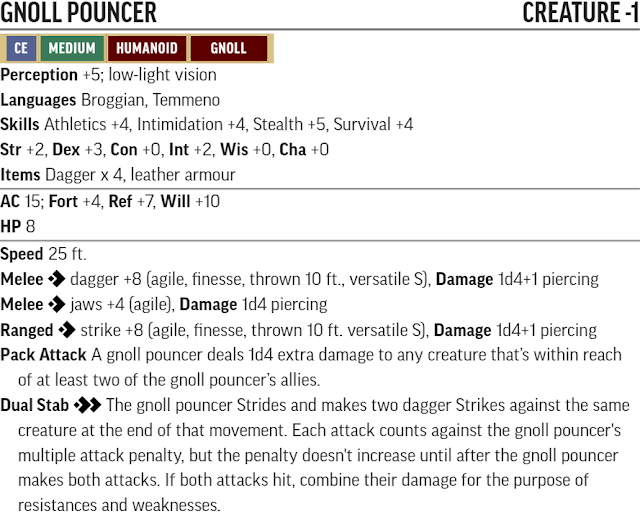
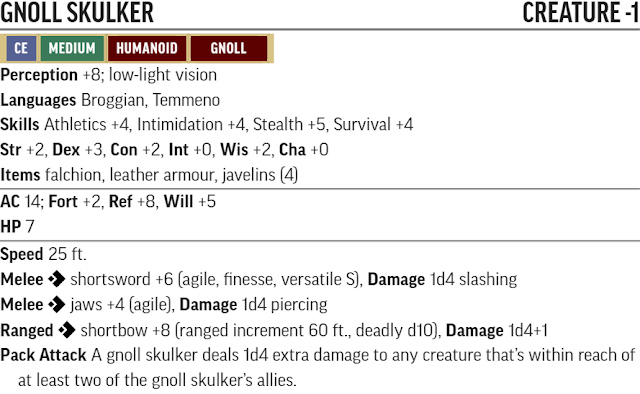
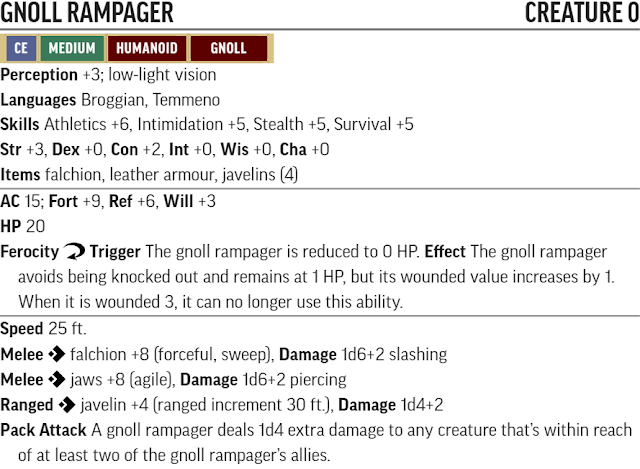
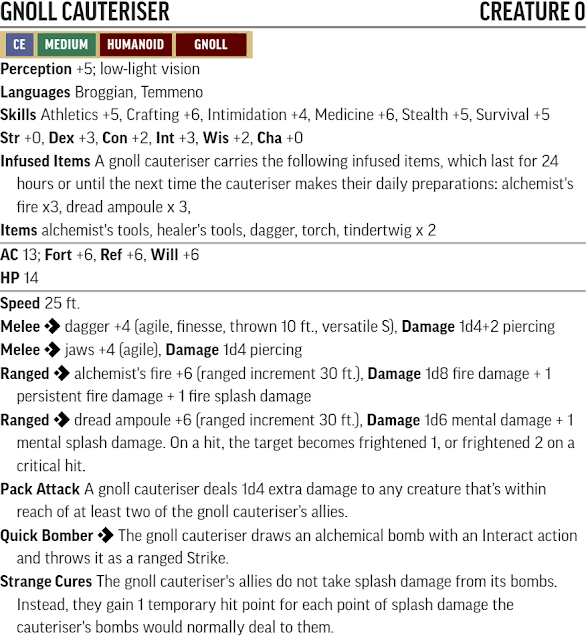
Some Gnoll Opponents for PF 2e

The island of Ursino (not-Corsica) on Verra has a bunch of gnolls. The gnolls are cursed mercenaries who were brought in as exiles from the Temmeno Empire (the not-Ethiopian Empire) over a generation ago by the Banco di Asmodeo to exert the banks control over the island and beat back swarms of the undead. A few missed payments, broken promises, and angry contractual negotiations later, and they're now organised into roving bands threatening the inhabitants of Ursino and are looking for a way off the island to go back home. 

These gnolls are sort of based off of the buda spirit from Ethiopia, tho' only very loosely, and with any anti-semitic elements totally scrubbed. Buda accusations IRL can be used for anti-semitic purposes, but are used more widely to handle breakdowns in social relations. For more see Hagar Solomon's book The Hyena People: Ethiopian Jews in Christian Ethiopia, Tom Boylston's "From sickness to history: evil spirits, memory and responsibility in an Ethiopian market village", and this book chapter about a recent contemporary buda crisis. The part that particularly interests me about budas is their use to express the anxieties of subsistence farmers about integration into the market economy, which is very on-theme with Verra's focus on the 17th century emergence of global capitalism in a fantasy context.

So these gnolls are bad people who have practiced cannibalism and been cursed by the Hidden God to take hyena features for it, one of a larger class of beast peoples originating in this way. They reproduce by spreading the curse - making other people eat dead bodies so that they in turn become gnolls. Ultimately, their goal is not to wipe out the inhabitants of the island or whatever, but to get a few ships and either the crews to operate them or knowledge of how to sail them themselves, and then to go home (where, truthfully, they will be no more welcome; the Temmeno don't want cursed cannibal mercenaries they've already exiled coming back)

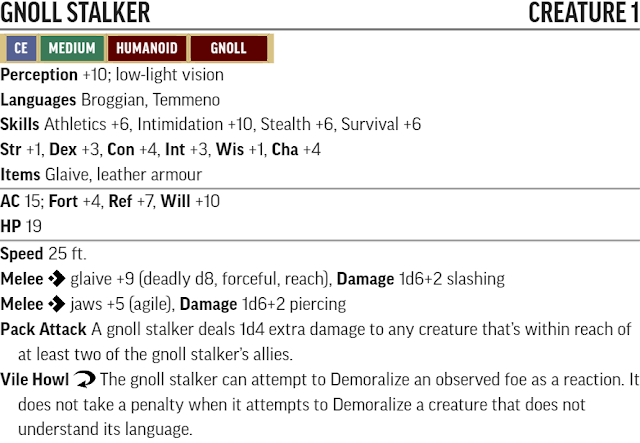
There are three gnolls in Pathfinder 2e as it exists: one level 2, one level 3, and one level 4. I wanted PCs to be able to fight gnolls right from the start of the game, so I created a bunch of -1, 0, and 1 level gnolls, which will be especially helpful once the PCs hit levels 2-4 and I can send big hordes of the low level ones after them. I created these gnolls using the PF Tools Monster Builder, and I think there are a few typos where I forgot to change gear or names on powers, but the numbers should all be right.

So with that long introduction, here are some low level gnoll opponents for you to use.


Anyhow, enjoy!

Sep 1, 2021

Blogs on Tape Does the Six Cultures Essay

Blogs on Tape recorded my Six Cultures of Play article for anyone who finds reading giant walls of text difficult.

I've been featured three times previously on Blogs on Tape, all in 2018.

Tests of Skill and Tests of Chance [Original article]
Considerations on Restocking the Dungeon [Original article]
Layers of the Sandbox [Original article]

Thanks Nick!

(Disclosure: Nick of Blogs on Tape and I are friends and have played games together off and on since 2012)

The summer has continued to be busy, especially as COVID-19 spreads rapidly through the poorest parts of the world, combining with natural disasters and political instability to create a great deal of work. I am delayed on both a response to questions and an article I hope to write at some point following up on the six cultures piece about Vampire: the Masquerade's influence on roleplaying. My apologies for the continuing delay.

At the same time, Blogger has decided it will not let me add more blogs to my sidebar (thus adding to a growing list of incapacities including my inability to comment on my own blog or anyone else's)? The backend of this blog seems to grow less and less functional over time. There are a number of interesting responses people have written to the original article on their own blogs, and I am thankful to everyone who shared it, commented, link to it, and so on, but there are two I'd like to point to in particular.

Chiquitafajita wrote an excellent three-part series using Lacanian psychoanalysis about the structure of desire in roleplaying games: Part 1, Part 2, Part 3 It's a great use of existing academic tools for the analysis of literature (while critical of Lacan's version of psychoanalysis, I think CF is judicious in its use and doesn't rely on the most questionable propositions of the system).

Gus of All Dead Generations has also written the first three parts of a series outlining his beliefs about classic play, and how he wants to rejuvenate it. Part 1, Part 2, Part 3. I am looking forward to more.

Jun 22, 2021

A Time Tracker For You

I am planning to respond to the comments on the "Six Cultures" essay, but it's been a busy few months. I work for an organization that deals with international crises and you may have heard of a few going on lately. I have also recently been vaccinated and am trying to (safely) re-establish social connections with others and enjoy the great outdoors. I've also been doing (some) wedding planning since I am getting married next year. All of this has meant analysing why Reddit was mad or whatever has been a low priority, tho' I do intend to get to it before the end of the summer.

To tide everyone over, here is a time tracker I put together for someone who will be refereeing their first game sometime in the next week or two. They are setting it in Mystara and running through the B-series of modules supplemented by the Vaults of Pandius fan material and the Gazetteers. I like helping out new dungeon masters and referees, so I'm always happy to create these sorts of things and then share them in case others might find them useful.

Each instance of this tracker covers one day's progress, breaking it down into six watches of four hours each, and then each watch into 24 turns of 10 minutes each. It's meant to be used by the timekeeper role, so I wrote my personal notes on lighting durations under the day-hex, but you can swap in your own preferences, obviously. Fairly standard stuff, but I hope you find it useful.

Download link (jpg)

It even has a hex on it.


Dec 30, 2020

Trapplications II

Five years ago, I wrote the original Trapplications post. After years of updating it based on use, it's time to present the more streamlined version I've adopted. This version is better for stocking and restocking dungeons, while also remaining usable in play as a "wandering trap" table.

To recap: To use this table, you roll 2d6 and 1d6 at the same time and the results determine which entry on the grid occurs. If using it during play, I roll about once per 10-minute exploration turn because it's easier to remember to do it that way. If I'm using it for stocking, I roll it once per room, and then once more per room every time I restock the dungeon, and occasionally for corridors with prominent room-like features.

The big update is the categories for the 1d6. I redesigned them because these ones are easier to understand and less work to create than the old set, with a clear progression in proximity, danger, and imminence between the three options on the table, and the need to only create 3 columns of content instead of a full six.

They are now:

1 - Null
2 - Null
3 - Null
4 - Signs
5 - Danger Zone
6 - Trigger

"Null" results mean nothing - no trap, no problem. These results help with stocking by ensuring that some rooms lack traps. 

"Signs" means indirect signs of the trap's operation - corpses strewn around, poison darts littering the floor, the sound of grinding gears or whirring blades far ahead. The intent is that they can be spotted ahead of the trap being an actual danger.

"Danger Zone" means one or more PCs find themselves in the area of effect of a trap that has not yet activated. When stocking, it means that trap has an area of effect that one can enter into without automatically triggering the trap. If the PCs freeze in this state they'll be fine, but the challenge is to extricate themselves without triggering the trap (perhaps by dismantling or jamming it?).

"Trigger" means that a trap triggers or is about to trigger with a PC in its area of effect. When stocking, it means a trap that can't be noticed through passive observation until it's triggered (a careful search of the area might reveal it ahead of time). 

I tend to make the entries here the actual triggers of the traps, even tho' this will require a bit of adaptation if you're using it in play when the specific object isn't necessarily present. Reusing triggers for traps helps PCs learn what kinds of things in this dungeon are likely to be dangerous and gives them an extra chance to avoid them, while also bringing a certain conceptual coherence to the traps.

The probability here is that 50% of rooms will have traps, and only 1 in 3 traps will immediately trigger without warning, which I think is frequent enough to be dangerous but not frequent enough to slam a halt on exploration. I recommend attaching "Trigger" results to interactable objects whenever possible

If you feel that's too many, I'd use a d8, push "Trigger" to 8, "Danger Zone" to 7, "Signs" to 6, add a "Broken" column at 5, and leave the rest as nulls. That reduces the number of traps that are difficult to discover beforehand to 12.5%.

"Broken"
implies a trap that's been activated and not reset, or that has broken down from age. Broken traps are a great way to telegraph that there are traps around, and create a sense of danger without actually requiring time to resolve in any detail.

Here's an example of this larger table:


Happy new year!

Apr 26, 2019

The Big Dawnlands Reference Documents

I'm sure after a decade of me talking about the Dawnlands in bits and pieces, people are eager to actually get a true overview of the setting. As part of my new Dawnlands campaign, I wrote up a 25-page reference document for my players. I also wrote this 8-page campaign pitch for my new PCs which specifically focuses on one sept of the Kadiz.

The idea wasn't that they would read the either document in full in one sitting, but rather that they could refer to them as needed, and dip into them to gin up ideas for their characters.  It also helped my organize my thoughts and present a "conceptually dense" version of the setting that was laid out as something other than a series of vignettes, disorganised reflections, and occasional partial introductions.

I cranked these out in about four days of writing after my workday, so it's not my finest and most evocative work (rereading them, I notice the usual mishmash of sub-typos present in that sort of work), but I hope people find it interesting.

Oct 11, 2018

A Brief (Re)Introduction

My blog traffic has suddenly picked up through a combination of reblogs, Reddit comments, mentions in Youtube videos, and people adding me to RSS feeds as G+ slowly wraps up. I figured it was time for a reintroduction for all of you new readers.

I've been playing roleplaying games for 28 years now, since I was eight years old. I started with Palladium Games' TMNT and Other Strangeness before moving to the Rules Cyclopedia of D&D and from there through many other games in the intervening decades before coming back to old school D&D.

I play a lot of different games, but I mainly write about Mythras, Openquest, Stars Without Number, and my own "neo-clone" of old school D&D, Into the Depths. I also write a fair bit about my ideas about playing the game, though I try to keep the theory-posting to mostly practical matters. My two main campaign settings are a Central-Asian-inspired psychedelic dark fantasy setting for Mythras called "The Dawnlands"; and a gonzo post-apocalyptic afterlife setting for Into the Depths called "Necrocarcerus" that satirises a lot of the tropes of D&D.

The most important considerations I have when running games include information presentation and accessibility; creating surprise and wonder during play; how to shape and vary the risk PCs face and the agency and control they have; distributing tasks throughout the entire play group (but not "GM-less" play); the operation of incentive systems and social dynamics; creating "living worlds"; and all sorts of play that don't involve the imposition of narrative control by the referee on PCs, but that nonetheless emerge into satisfying situations evocative of the best parts of fantasy and science fiction narratives.

The things I've written that people have found the most useful (as determined by page views, reblogging, copying into their own games, etc.) are:

My redesign of the traditional wandering monster table
My extension of the concept to handle traps 
My use of it to populate and repopulate dungeons as the PCs pass through them
My use of it to determine magical item components
My use of it to create radiant quests
My notes on randomly determining how tables can interact with one another

My notes on running "technical plots" (Plots where a situation has to be resolved through a technical solution instead of punching someone out).
My thoughts on designing rules to make them feel like more skill or luck in involved
My thoughts on how to determine what you need to come up with houserules for
My reviews of popular OSR products

My procedure for PCs who are exploring the wilderness in hexcrawls
My chase rules
My teamwork rules for Into the Depths (Mythras, Openquest)
My perception rules
My alchemy rules for Necrocarcerus
My rules for treating backstories and knowledge as types of gear

My ideas about moving beyond the party-structure in RPGs
My ideas about PC roles (and here's an update on which ones I use these days)
My ideas about letting PCs make rolls for things like wandering monsters

Welcome!

Jun 17, 2018

A Proposal for Designing Rules

My proposal is that the referee ought to:

1) Keep track of recurring questions that the PCs ask them
2) Decide whether these have interesting but uncertain answers
3) Establish rules that balance PC agency and randomness for the ones that do
4) Explicitly dismiss the ones that don't have interesting answers as irrelevant to play

This sounds simple and yet is widely ignored in actual rules design. For example, one can find dozens of minor tweaks of how combat works in various versions of D&D, but very few designers have developed anything covering "Can we find a good spot to camp for the night?" One might say that's not an interesting question, though that position is difficult to maintain if one is also rolling encounter checks overnight.

A few years ago, I created my own rules for chases because I found that despite the frequency that chases appeared both in games and in related material, no one really wrote rules that covered them very well (a few people had written rules for fleeing that resolved doing so in a single roll and were mainly intended to be used by the PCs when fleeing monster).

On particularly appalling oversight is lacking teamwork rules. "Can I help?" is such a common question PCs ask, and yet anything other than a blind methodological individualism is uncommon. Long-time readers will remember that I was shocked to discover that the One Ring game doesn't even have rules for PCs to help one another with ordinary tasks. I've spent a lot of time coming up with teamwork rules for Mythras, Openquest, and Into the Depths because their absence in other games drove me up the wall.

I think there are many more examples of recurring questions at tables that have no rules or procedures to resolve them that probably should, and that effort to design new rules would probably be much better spent on them than elsewhere.

May 9, 2018

Into the Depths: Errata Already

Beloch of Papers and Pencils (one of the original playtesters) very kindly walked me through a number of ambiguous wordings and suggested some minor rules changes for Into the Depths. I'm grateful for his keen eye, and have incorporated most of them in. As a result, eight days after my first major update to the rule system in two years, here is the new version of Into the Depths incorporating Beloch's suggestions and a few minor changes I decided on after hitting publish last time.

Most of the changes are very minor. You'll notice slightly clearer wording in the grappling section, the sections where carrying capacity is explained (backpacks now let you carry 8 + / - Armour Mod. items, with special Frame Packs adding +3 to that capacity), auction catalogues let you assess the value of things slightly more easily, and some minor formatting, punctuation and phrasing changes in a few tables and other sections. I also removed a rules loophole Beloch spotted, where you could spend a day creating a new spell and suddenly gain half a level repeatedly. That's been changed so that creating spells no longer qualifies, only creating magical artifacts does.

If you're not sure what version of Into the Depths you have, I've been date-coding them for a while, so this update is 20180509, versus the version without errata, which is 20180501.

May 1, 2018

Happy May Day: New Into the Depths

It's May Day today, and in the spirit of the day, here's a brand new expanded version of Into the Depths for free! (Link is to a downloadable pdf on Google Drive) (2018-05-11 edit: I've now changed the link to the newest version incorporating errata)

Into the Depths is my "core" ruleset for playing old school fantasy adventure games, as conveyed in four densely written pages. I've been running and playing in games using it for a little over two years now, and this is the first major revision since 2016, with the revisions based on my experiences playtesting it over that period.

Into the Depths might be the game for you if you're looking for a low magic rules-set that mechanically encourages dynamic fights and chases and that has a stellar gear list that serves in place of a power or magic system in most instances.

New material includes:
More gear options
More secret fighting techniques to learn
A magic system
An updated levelling rubric
The ability to be bad at things
Rule sections rewritten for clarity and ease of use
Numerous tweaks to the mathematical structures

One last change is that I'm opening up the copyleft on it further. Previous versions of Into the Depths were available under a noncommercial Creative Commons license. This newest revision is now available for commercial use (with attribution) for anyone who would like to publish and sell works using it as the ruleset.

Feb 21, 2018

Into the Depths: Your Feedback

So I'm soliciting your feedback, internet community, on Into the Depths (link is to pdf download). For those just tuning in, Into the Depths is a classless, attributeless retroclone that I wrote at the end of 2016 that incorporates most of my favourite houserules from years in OSR games. It should be compatible with almost any d20-lite ruleset (Swords and Wizardry, Microlite20, etc.). I spent 2017 playtesting it, and I have some ideas for new material for an upcoming revision, but I thought I'd ask you, the wider old-school D&D community, to take a look at it and collect your feedback.

I'm particularly interested in any parts you think need clarification, expansion, or simplification in the rules as written.

Here's a link to some of the changes I'm planning to make based on my own playtest of it. I'm also planning to condense the experience milestones into a smaller list, add some overland travel rules, and a magic system of some sort. This will eventually become the core system of Necrocarcerus if I ever publish that setting, and it's creative commons so you can use or adapt it for your own ends as well.

Jan 23, 2018

Self-Plug: My Essay in Megadungeon #2

Courtney Campbell's Megadungeon #2 zine is out. I contributed an essay that's basically a cleaned-up and consolidated version of my blog posts on wandering monster tables and restocking dungeons that should be easier to follow and use. If you're looking for all of that in a single easily-referenced spot, you might want to check out the zine (it's got a bunch of other good stuff in it as well).

I got paid (very fairly) a per-word fee for the article, so sales won't benefit me, but I think Courtney's doing good work with the Megadungeon series (issue #1 here), and I'm probably going to be contributing to future issues as ideas come to me, so I encourage you to check it out.

Oct 1, 2017

Into the Depths Revisions After Playtesting

I haven't yet rewritten Into the Depths nor asked my dear pal Chris Huth to remake the one-page version, but I have been playtesting it a lot this year via my Feuerberg campaign. I've been collecting player feedback, and noting my own feelings about things, and here's what I'd change:

1) I'd increase saving throws to success on a 16+ instead of a 14+. This would make it harder to save, and make bonuses to your roll from gear and the like more important. It starts you off with a 25% chance of saving, instead of a 35% chance.

2) I'd pull the helping rules out into a separate section called "helping" since the "Turn your 1d6 roll into a 1d8 roll" rule seems to be the most commonly overlooked rule in the game, and its current placement under risky and dangerous actions make it appears like it only applies in those circumstances, as opposed to more generally..

3) Shift getting "Good Ats" to odd-numbered levels instead of even-numbered levels so that you get your bonuses spread more evenly across levels - improvements to your scores on even levels and Good Ats on odd ones. As it currently stands odd-numbered levels are comparatively dead, while all improvements happen on even levels.

4) I don't know that I'd use it in my online games where we tend to have more of a "pawn" style of play, but I'm strongly tempted to add a rule where when you camp, if you tell a unique story that relates to your character's backstory and describes them doing something interesting, you can become Good At that one thing for the rest of the adventure. Alternately, I might make this the effect of a boozy party item.

5) I should probably add some Bad At rules where you only roll a d4 instead of a d6, with each Bad At giving you another Good At.

Those are the main changes I've noticed and wanted to make, though if any readers out there have more, I'd be willing to take them under consideration.

May 28, 2017

Into the Depths of Feuerberg

I'm going to be running a campaign in Feuerberg (the dragon volcano megadungeon) on Saturdays from 11am EST to 3pmish EST. If you're interested in joining, let me know.

Into the Depths Single Page Rules Summary
Into the Depths Character Sheet created by Beloch Shrike of Papers and Pencils
Into the Depths of Feuerberg (the setting guide)

The shops and gear are on the last two pages of the document, but I'm putting them up in this post so that people can refer to them more easily. Only new pieces of gear with mechanical effects have descriptions. If it says something like "4+" that means "on a result of 4 or higher when rolling 1d6".

(I'm probably going to write an entire post about the pocketwatch item and time-keeping in games at some point; and another about Grunewald's Almanac)

Vendors in Hoch
(Prices in silver unless otherwise noted)
Shops will buy rare, unusual and interesting items related to their wares.

The Dragon’s Claw – run by Gunther Kant

Ammunition
Small Barrel of Corned Gunpowder – Explodes for 3d6 damage in 5m diameter (gold)
Dagger (small)
Custom-Made Obsidian __________ - Allows hitting incorporeal undead and spirits
Flintlock Carbine (ranged)
Full Brigandine Suit (medium armour)
Halberd (great)
Sabre (melee)
Shield
Spear (great)
Leather Jack (light armour)
Reinforced Field Plate Panoply (heavy armour) (gold)
Repair Kit – Repair weapons and armour on a 4+
War-Axe (melee)
Zweihander (great)

Church of the Hidden God – run by Yazdan Burjani (gold)

Copyist’s Kit – Allows accurate copying of documents
Fatwas Against ________ - Scrolls of protection
Healing Grievous Wounds
Holy Symbol – stun nearby undead for 1d4 rounds on a 5+
Regeneration of Lost Parts
Removal of Curses
Shriving of Sins
Vials of Holy Water

Can initiate someone as a priest of the Hidden God (10,000 sp)

The Golden Sun Coffee House – run by Madame Kularka (gold)

Excellent Booze
Excellent Coffee
Excellent Tea
Fortune Read
Introduction to Esteemed Personage
Hot Tip

The Hall of Zagros – run by Ranit Anuniat

Antitoxin
Backpack
Bandages
Bedroll
Caltrops
Cartographic and Surveying Equipment
Chalk
Climbing Equipment – Climb surfaces on a 4+
Cold Weather Clothing – +4 on saves vs. exposure to cold
Crowbar – Break open doors and chests on a 4+
Firestarter
Flare – Blinds all within 5m radius for 1d6 rounds unless they save
Hammer and Chisel – Allows carving, breaking and driving things into rock
Iron Rations
Iron Spikes
Lantern
Protective Gloves – Protects hands from acid, poison, heat, etc. Cannot do tasks requiring fine motor coordination while wearing them.
Sack
Saw
Shovel
Tent
Tongs
Torch
Whistle

The Hangs – run by Greta Verstirwung (copper)

Bullshit Story
Fried Noodles
Godawful Beer
Stolen Goods
Terrible Whiskey
Warm Beds – Recover 2d8 HP / day of rest

The Hausenner Ranch – run Friedrich Haussenner, Esq.

Bag of Flour
Block of Wax
Butchering Kit – Allows harvesting of monster organs, trophies, etc.
Butter
Chicken
Dangerous Animals Tamed (gold)
Donkey (mount)
Riding Horse (mount)
Fresh Sausages
Gallon of Milk (copper)
Milk Cow (gold)
Mutton

Olonwe’s Bazaar of Wonders – run by Olonwe

Cartographic and Surveying Tools
Compass
Document Case – Protects documents against exposure to fire and water
Fiddle – Can calm beasts, demons, and undead
Fine Tools
Current Edition of Grunewald’s Northern Almanack – Answers questions about flora, fauna, geography, seasons, and astronomical phenomena in Feuerberg on a 4+.
Heliotrope
Lock & Key
Mirror – Reflects gaze attacks back on a 5+
Periscope – Allows looking around corners while remaining concealed
Pocketwatch – Allows accurate tracking of time
Songbox – Plays music
Telescope – 10x vision of far objects

Sebastus Wright, Magus (gold)

Dose of Paralysis Poison – Save or be paralysed for 1d6 turns
False Air Capsule – Don’t need to breath for 2d6 hours
Ghost-Blinding Flares – Save or blinds incorporeal undead for 2d4 rounds
Ghost-Translating Skull – Allows one conversation with a dead person
Hekaphage Talisman – Allows reroll of one failed saving throw vs. magical effect
Lens of Decipherment – Translates one document into High Krovian
Oracular Incense – Augury for one question when burnt
Plasmic Key – Opens one non-magical lock
Spider Eye – Comes to life for 2d6 rounds and explores at MV 3
Soul-Trapping Canopic Jar – Incorporeal undead or spirit must save or be trapped within
Vial of Acid

Can initiate someone into the Silver-Veined Sodality for 10,000sp

Town Hall – run by the Burgher Council (gold)

Business License
Citizenship (platinum)
Confusing, Frustrating and Punitive Taxes
Freehold Land Grant – Necessary to establish a permanent home base
Licensed Advocate

Additional special vendors are available upon completion of certain quests.

Apr 9, 2017

Into the Depths: Update

A new, updated version of Into the Depths.

I added a clarification of how you sneak, changed being good at something to giving you a +2 instead of just increasing your die type (so you can both apply it potentially to saving throws or attacks, as well as allowing you to stack it with someone helping you), changed how surprise works (each side now rolls to surprise the other), and I updated the wandering monster table slightly to match the current categories I use. I say I did this, but really I just came up with the rules and C Huth did all the hard work of laying them out.

Anyhow, enjoy.

Dec 24, 2016

Merry Christmas

I decided that rather than struggle doing conversions of various retroclones / neoclones, I might as well just write another one (the first one was Microlite Iron Heartbreakers). Here it is: Into the Depths. It's free for download and you're welcome to modify it however you please.

It's a chassis that I'll be building off of and using for Necrocarcerus and other fantasy campaigns, loosely inspired by the size and rules minimalism of Searchers of the Unknown and Into the Odd, with bits and pieces of my favourite house rules in it, and based off my experience using various versions of Swords and Wizardry. It's meant to be easy to plug material from other games into - my become-a-wizard rules for it will be some mixture of Wonder and Wickedness with the spell research rules from Crimson Pandect. It's classless, with minimal stats to keep track of, and is almost entirely the player-facing elements of the rules. I stuck in an upgraded version of my leveling rubric for the Black Hack, since that seemed popular with folks.

Anyhow, merry Christmas and enjoy!

Dec 15, 2014

Old Files Now on Google Drive

The Tellian Sector, complete with map, planetary profiles, and a listing of active espionage organisations in the Tellian system itself.

Backgrounds for Moragne, my Runequest 6 / Legend / Mongoose Runequest 2 setting loosely modeled after Angevin England. Suitable for any JAFE (Just Another Fantasy Europe) setting.

My overland travel reference sheet for the Moragne campaign.

The primer for my Moragne campaign.

My potion tables for use with my alchemy rules. These are built off of procedural metapharmacology.

Iron Heartbreakers v. 1.52, my Microlite20 swords and sorcery game inspired by Iron Heroes. It's ideal if you want low or no-magic PCs.

The Necrocarcerus v. 1.1 rules document as well as a map of Necrocarcerus showing rail connections. Also, a copy of the wandering monster table for SAFE AREA DUVANOVIC, a mini-campaign setting within Necrocarcerus that I'm writing.

Feb 2, 2012

Cheat Sheet for Mongoose Runequest 2 / Legend

Download it here (187 KB pdf).

It's a collection of all the little rules that I kept on having to look up but weren't worth having bookmarked. It includes combat actions, falling damage, the locational hit chart, calculating strike rank, armour penalty and movement speeds, as well as a few other things. I used to print it on the bank of the combat manoeuvres cheat sheet that Mongoose used to offer but which appears to have vanished off their website. I have a pdf copy but an unsure about whether it's legal to upload it or not? Anyhow, between the combat manoeuvres sheet and this cheat sheet, you spend far less time flipping through the book, so enjoy!