Mar 8, 2023

What Have I Been Up to?

It's been a while since I've updated this blog, so here's a brief apology and explanation of what I've been up to instead:

I've been playing a bunch of 5e. Broad strokes, I'm in one weekly campaign, and one campaign that is going from biweekly to three-times a month. The former is Al-Qadim meets Dark Sun, the latter Dark Ages Arthuriana. I don't really love 5e as a system, and I'm skeptical of D&DOne as an improvement on it, but good groups can make even a mediocre system serve as the basis for a great campaign.

I was running a Pathfinder 2e campaign, but a leak in my upstairs neighbours' apartment damaged the computer I had everything written out on, so it's on hold until I can get it fixed. Unfortunately, the money that I would normally have to do so went to paying out of pocket for veterinary care for two of my cats, one of whom has cancer. The other one is fine, but was stressed out - possibly by her lifelong friend having cancer. It cost me CAD 1,200 per cat to sort this out. This all came right before Christmas and the time of year I have to renew everything from my license to car insurance to my healthcard, which meant I'm tapped out until April.

Pathfinder 2e is great, and very fun to run as a referee, but just complicated enough that when you lose all of your notes for it, it's a non-trivial cost to replace them. I have them backed up in the cloud, but a key encounter planning tool has a computer-specific cookie it uses in place of a login, and until I can get the computer fixed, it's inaccessible. 

I will be running a game shortly. For the Arthuriana 5e campaign, we are doing character preludes where PCs take turns running sessions for the other players covering off one another's backstories. It's quite fun, basically a one-shot interlude. If you've never done it, it has the interesting side-effect of making PCs invest in one another' since you've got to plan an adventure based around someone else's backstory and then run it. I'm running a hunt for a white stag set in Scotland's Cheviot Hills where an aristocrat's bastard son will save the life of his older brother, the legitimate heir, and begin his journey to becoming a hero.

I also got a third cat, a now-eight-month-old kitten, a female ginger tabby (somewhat uncommon), the only survivor of her litter, who is a perfect blend of mischevious and good-natured. Her favoured class is definitely rogue, as her great delight is to run off with chopsticks, bits of paper, pieces of my wife's house plants (all cat-safe), stuffed mice, and other detritus making a sort of cackling trilling noise. She recently acquired fleas, despite being an indoor cat, and is undergoing her first course of flea killer. Here's a photo of the little trouble baby as she carouses in her pursuit of enough XP to get to level 2:

Ancestry: Goblin; Class: Rogue; Alignment: Chaotic Neutral

My upstairs neighbours (of the aforementioned leak) are also interested in playing "Dungeons and Dragons" at some point. I gave one of them my copy of Blades in the Dark to read over because I think it might be their speed, after my initial proposal to play Quantum Starfarer (an ultra-light version of Cepheus) was turned down. They're more interested in fantasy than in science fiction. They've never tried RPGs before, so I'm going to run an introductory game for them and their friends at some point this year. More on that when it happens.

Lastly, I'm changing jobs. I've been extremely busy with work over the past year, which is one of the major reasons I haven't been blogging. I'm hoping the new job comes with an improved work-life balance which will allow me to blog more this year.


Jun 5, 2022

Types of Terrain on Hex Maps

Someone on the OSR Discord server asked me to write this up in a blog post, so I thought I would talk a little bit about terrain for hex maps.

When I am creating hex maps for overland travel, I typically use 6-8 types of terrain so that I can assign them to a randomizer and have the PCs roll whenever I'm not sure what a given terrain type will be if I don't already know. The eight main types of terrain I use are:

1) Blight 
2) Desert
3) Forest
4) Hills
5) Mountains
6) Plains
7) Water
8) Wetland

I sort the terrain into three categories based on ease of traversing it:

Easy: Blight, Desert, Plains, Water (with watercraft)
Difficult: Forest, Hills, Wetland
Impassable: Mountains, Water (without watercraft)

Easy terrain allows PCs to move through it at their normal movement (10km per 4 hrs of travel per the Procedure for Exploring the Wilderness Redux). While following a path in easy terrain, you cannot get lost.

Difficult terrain has PCs move through at 1/2 the normal rate (two travel actions must be taken to cross it). Paths across difficult terrain double your movement: It costs one travel action to move across the hex).

Impassable terrain cannot be traversed unless the PCs find a path across it, and they can only traverse it in the direction the path does. Paths across water can represent significant shallows or fords or small island chains close enough to swim from island to island.

Within these terrain types, I aim for a certain level of variation based on what makes sense for a given area. In a setting based on Scandinavia (all the rage right now), a desert will be an alvar pavement, a forest will be mostly coniferous, and wetlands will be bogs. In a setting based on Nigeria, wetlands will be flood forests, a forest will be an acacia / peacock flower / long grass mosaic, and hills will be a classic West African highland rise. I don't bother to mechanise this fine a set of details.

I find this tends to incentivise looking for paths, especially when PCs want to cross formidable natural barriers like mountains or lakes.

Feb 20, 2022

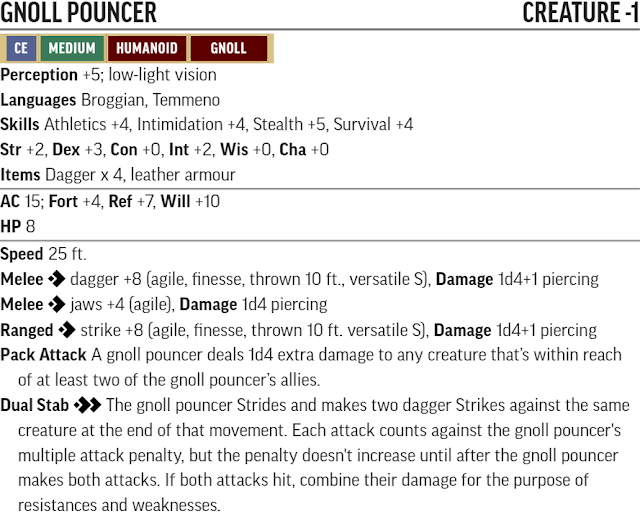
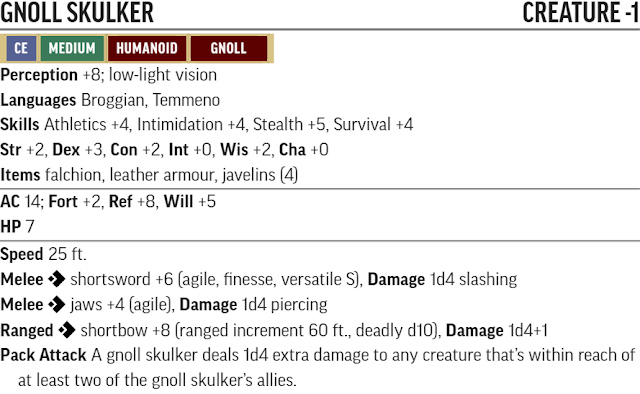
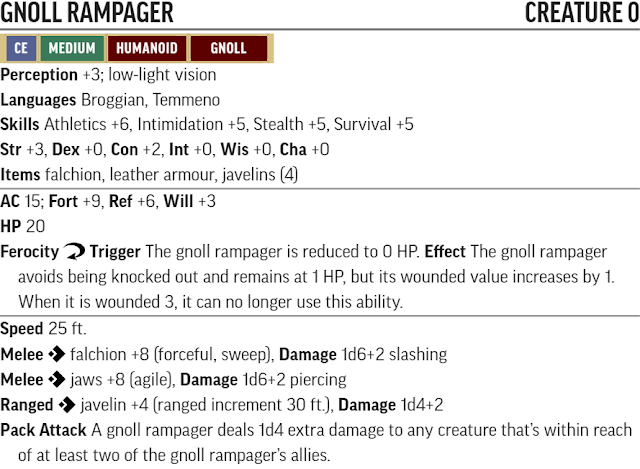
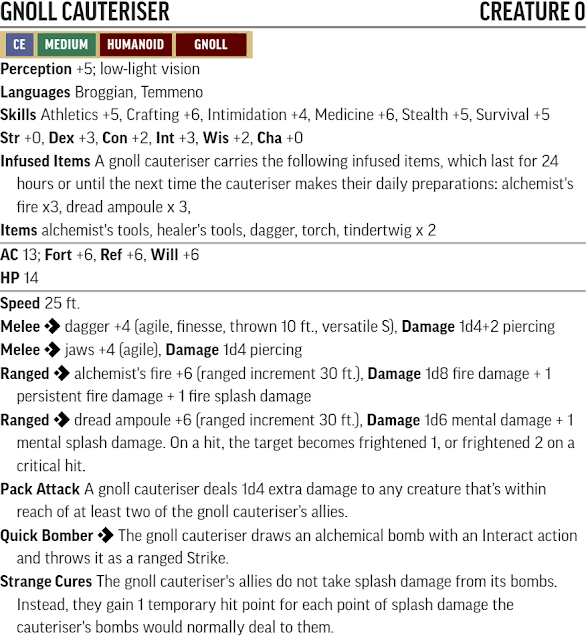
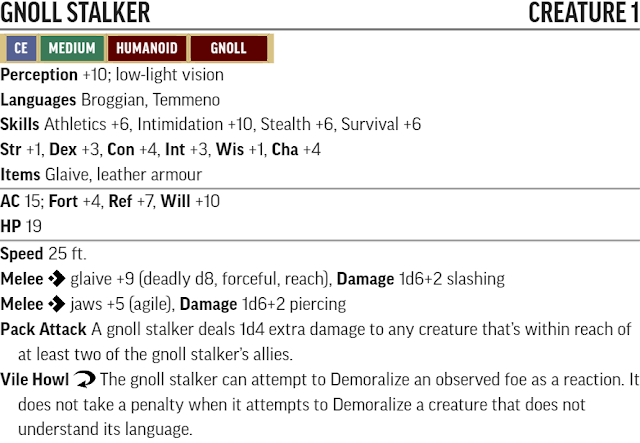
Some Gnoll Opponents for PF 2e

The island of Ursino (not-Corsica) on Verra has a bunch of gnolls. The gnolls are cursed mercenaries who were brought in as exiles from the Temmeno Empire (the not-Ethiopian Empire) over a generation ago by the Banco di Asmodeo to exert the banks control over the island and beat back swarms of the undead. A few missed payments, broken promises, and angry contractual negotiations later, and they're now organised into roving bands threatening the inhabitants of Ursino and are looking for a way off the island to go back home. 

These gnolls are sort of based off of the buda spirit from Ethiopia, tho' only very loosely, and with any anti-semitic elements totally scrubbed. Buda accusations IRL can be used for anti-semitic purposes, but are used more widely to handle breakdowns in social relations. For more see Hagar Solomon's book The Hyena People: Ethiopian Jews in Christian Ethiopia, Tom Boylston's "From sickness to history: evil spirits, memory and responsibility in an Ethiopian market village", and this book chapter about a recent contemporary buda crisis. The part that particularly interests me about budas is their use to express the anxieties of subsistence farmers about integration into the market economy, which is very on-theme with Verra's focus on the 17th century emergence of global capitalism in a fantasy context.

So these gnolls are bad people who have practiced cannibalism and been cursed by the Hidden God to take hyena features for it, one of a larger class of beast peoples originating in this way. They reproduce by spreading the curse - making other people eat dead bodies so that they in turn become gnolls. Ultimately, their goal is not to wipe out the inhabitants of the island or whatever, but to get a few ships and either the crews to operate them or knowledge of how to sail them themselves, and then to go home (where, truthfully, they will be no more welcome; the Temmeno don't want cursed cannibal mercenaries they've already exiled coming back)

There are three gnolls in Pathfinder 2e as it exists: one level 2, one level 3, and one level 4. I wanted PCs to be able to fight gnolls right from the start of the game, so I created a bunch of -1, 0, and 1 level gnolls, which will be especially helpful once the PCs hit levels 2-4 and I can send big hordes of the low level ones after them. I created these gnolls using the PF Tools Monster Builder, and I think there are a few typos where I forgot to change gear or names on powers, but the numbers should all be right.

So with that long introduction, here are some low level gnoll opponents for you to use.


Anyhow, enjoy!

Jan 18, 2022

Openquest 3 SRD Released for Free

 There is now a system reference document (SRD) available for Openquest 3rd edition. The SRD is free to download from this link, and will eventually be hosted as a HTML document on the d101 Games website here.

I haven't had time to write an in-depth review of Openquest 3rd edition, but the changes are substantive and wide-ranging from the first two editions, and overall they are positive cointributions to the system. Openquest's 3rd edition keeps its place as one of my two favourite implementations of the Basic Roleplaying system (BRP) alongside Mythras. 

Mythras appeals to the lover of crunch in me, but Openquest is an excellent, rules-light version of BRP that keeps many of the details that appeal to fans of BRP while simplifying and economising many of the rules that newcomers find fiddly. I think it's one of the best introductions to BRP that one can get. If you want a system that does not have levels, classes, or inflating HP, that makes combat feel deadly and exciting, and that sharply distinguishes between how different kinds of magic work, you might find the BRP family, and in particular Openquest, a product that appeals to you.

Along with the SRD, there is a free quickstart scenario and rulebook that contains most of the rules (it leaves out some of the magic systems available in the main rulebook).

Dec 27, 2021

Placing Locations in Hexes

Here's a simple and fast system for placing locations of interest in a single hex on a grid. I am assuming a four hour watch as the basic unit of travel movement. Hexes can be divided into six equilateral triangles, for anyone who didn't know that.

1) Number the six triangles of the hex in clockwise order starting from the top

2) Roll a d6 and a d4

3) The d6 determines which sub-triangle of the hex the location is in. The d4 determines how many hours of travel into that triangle the location is (4 is the centre).

Variant: You could use d4-1 if you prefer fewer things in the centre and more things by the edge.

That's it, that's the whole system. I find it very fast in practice, and you can use a simple notation in your key to track this that looks like:

AA:17 Haunted Castle (1:3) 

where "AA:17" is the hex coordinates and "1:3" is sub-triangle and hours of travel in.

When the PCs search a hex randomly, they either pick one of the six sub-triangles, or the referee can roll a d6 for which sub-triangle they search if they have no preference. I make each search take a single watch.

The speed really helps here with populating a lot of content into hexes.

Sep 1, 2021

Blogs on Tape Does the Six Cultures Essay

Blogs on Tape recorded my Six Cultures of Play article for anyone who finds reading giant walls of text difficult.

I've been featured three times previously on Blogs on Tape, all in 2018.

Tests of Skill and Tests of Chance [Original article]
Considerations on Restocking the Dungeon [Original article]
Layers of the Sandbox [Original article]

Thanks Nick!

(Disclosure: Nick of Blogs on Tape and I are friends and have played games together off and on since 2012)

The summer has continued to be busy, especially as COVID-19 spreads rapidly through the poorest parts of the world, combining with natural disasters and political instability to create a great deal of work. I am delayed on both a response to questions and an article I hope to write at some point following up on the six cultures piece about Vampire: the Masquerade's influence on roleplaying. My apologies for the continuing delay.

At the same time, Blogger has decided it will not let me add more blogs to my sidebar (thus adding to a growing list of incapacities including my inability to comment on my own blog or anyone else's)? The backend of this blog seems to grow less and less functional over time. There are a number of interesting responses people have written to the original article on their own blogs, and I am thankful to everyone who shared it, commented, link to it, and so on, but there are two I'd like to point to in particular.

Chiquitafajita wrote an excellent three-part series using Lacanian psychoanalysis about the structure of desire in roleplaying games: Part 1, Part 2, Part 3 It's a great use of existing academic tools for the analysis of literature (while critical of Lacan's version of psychoanalysis, I think CF is judicious in its use and doesn't rely on the most questionable propositions of the system).

Gus of All Dead Generations has also written the first three parts of a series outlining his beliefs about classic play, and how he wants to rejuvenate it. Part 1, Part 2, Part 3. I am looking forward to more.

Aug 4, 2021

30 years

I picked up my first roleplaying game book in 1991, when I was eight years old. It was Teenage Mutant Ninja Turtles and Other Strangeness, which as an eight year-old, I thought was some sort of complicated Ninja Turtle comic / choose your own adventure (CYOA) novel crossover. My family was on what I think was March break in South Carolina, and I convinced my father to buy it for me (the main indulgence my parents gave me as a child was books). I was very surprised, upon reading it in detail, that it was in fact a game book, not a comic or CYOA novel. 

In August 1991, I went to a flea market at the school across the street from my childhood home, and found my first set of polyhedral dice (now long lost), a clear orange set someone was selling off with the rest of their AD&D stuff. I bought them for $5, the entirety of my allowance at the time. Shortly after acquiring dice, I began running my first "campaign" with my friends, a mostly incoherent collection of combat scenes involving various characters we had all created battling the Foot ninja clan. I like to think I've improved slightly in the intervening decades.

Overall, it's been a good thirty years of gaming. Here's hoping for at least another thirty.

Jun 22, 2021

A Time Tracker For You

I am planning to respond to the comments on the "Six Cultures" essay, but it's been a busy few months. I work for an organization that deals with international crises and you may have heard of a few going on lately. I have also recently been vaccinated and am trying to (safely) re-establish social connections with others and enjoy the great outdoors. I've also been doing (some) wedding planning since I am getting married next year. All of this has meant analysing why Reddit was mad or whatever has been a low priority, tho' I do intend to get to it before the end of the summer.

To tide everyone over, here is a time tracker I put together for someone who will be refereeing their first game sometime in the next week or two. They are setting it in Mystara and running through the B-series of modules supplemented by the Vaults of Pandius fan material and the Gazetteers. I like helping out new dungeon masters and referees, so I'm always happy to create these sorts of things and then share them in case others might find them useful.

Each instance of this tracker covers one day's progress, breaking it down into six watches of four hours each, and then each watch into 24 turns of 10 minutes each. It's meant to be used by the timekeeper role, so I wrote my personal notes on lighting durations under the day-hex, but you can swap in your own preferences, obviously. Fairly standard stuff, but I hope you find it useful.

Download link (jpg)

It even has a hex on it.


Apr 6, 2021

Six Cultures of Play

In this post I am going to present the taxonomy of the six main play cultures as well as a few notes about their historical origins. I am doing this to help people from different play cultures both understand their own values better as well as to encourage stronger and more productive cross-cultural discussion.

There are at least six main cultures of play that have emerged over the course of the roleplaying game hobby. There may be more: my analysis is mainly restricted to English-language RPG cultures, tho' at least three of them have significant non-English presences as well. In addition to these six cultures, there's a proto-culture that existed from 1970-1976 before organisation into cultures really began. 

A culture of play is a set of shared norms (goals, values, taboos, etc.), considerations, and techniques that inform a group of people who are large enough that they are not all in direct contact with one another (let's call that a "community"). These cultures of play are transmitted through a variety of media, ranging from books and adventures to individuals teaching one another to magazine articles to online streaming shows. A culture of play is broadly similar to a "network of practice" if you're familiar with that jargon. 

Individuals in the hobby, having been aligned to and trained in one or more of these cultures, then develop individual styles. I want to point out that I think talking about specific games as inherently part of some culture is misleading, because games can be played in multiple different styles in line with the values of different cultures. But, many games contain text that advocates for them to be played in a way that is in line with a particular culture, or they contain elements that express the creator's adoption of a particular culture's set of values.

The Six Cultures

1) Classic

Classic play is oriented around the linked progressive development of challenges and PC power, with the rules existing to help keep those in rough proportion to one another and adjudicate the interactions of the two "fairly". This is explicit in the AD&D 1e DMG's advice to dungeon masters, but recurs in a number of other places, perhaps most obviously in tournament modules, especially the R-series put out by the RPGA in its first three years of operation, which emphasise periodic resets between sections of the adventure to create a "fair" experience for players as they cycle around from tournament table to tournament table playing the sections.

The focus on challenge-based play means lots of overland adventure and sprawling labyrinths and it recycles the same notation to describe towns, which are also treated as sites of challenge. At some point, PCs become powerful enough to command domains, and this opens up the scope of challenges further, by allowing mass hordes to engage in wargame-style clashes. The point of playing the game in classic play is not to tell a story (tho' it's fine if you do), but rather the focus of play is coping with challenges and threats that smoothly escalate in scope and power as the PCs rise in level. The idea of longer campaigns with slow but steady progression in PC power interrupted only by the occasional death is a game play ideal for classic culture.

This comes into being sometime between 1976-1977, when Gygax shifts from his early idea that OD&D is a "non-game" into trying to stabilise the play experience. It starts with him denouncing "Dungeons and Beavers" and other deviations from his own style in the April 1976 Strategic Review, but this turns into a larger shift in TSR's publishing schedule from 1977 onwards. Specifically, they begin providing concrete play examples - sample dungeons and scenarios, including modules - and specific advice about proper play procedures and values to consumers.

This shift begins with the publication of Holmes Basic (1977) and Lost Caverns of Tsojcanth (1977), before eventually culminating in AD&D (1977-1979) and the Mentzer-written BECMI (1983-1986) line. Judges Guild, the RPGA, Dragon Magazine, and even other publishers (e.g. Mayfair Games) get on board with this and spread Classic norms around before Gygax and Mentzer leave TSR in late 1985 / early 1986. Judges Guild  loses its license to print D&D material in 1985, and the RPGA's tournaments have shifted away from classic play by about 1983. Most of the other creators at TSR have shifted to "trad" (see below) by the mid-1980s, and so the institutional support for this style starts dries up, even tho' people continue to run and play in "classic" games.

Classic is revived in the early 2000s when the holdouts who've continued to play in that style use the internet to come together on forums like DragonsfootKnights and Knaves Alehouse, and others, and this revival is part of what motivates OSRIC (2006) to be released. NB: This is the only name in this essay where it's not an autonym used by the practitioners themselves, tho' Gus L. of All Dead Generations is interested in many of their ideas and does call his own style "Classic".

One weird quirk of history is that people who were trying to revive classic in the early 2000s are often lumped into the OSR, despite the two groups really having distinct norms and values. Some of the confusion is because a few key notable individuals (e.g. Matt Finch) actually did shift from being classic revivalists to being early founders of the OSR. Because both groups are interested in challenge-based play, even if they have different takes on challenge's meaning, there are moment of productive overlap and interaction (and also lots of silly disputes and sneering; such is life).

This intermingling of people from different play cultures who initially appear to be part of the same movement but turn out to be interested in different things is pretty common - story games and Nordic LARP go through a similar intermingling before they split off into different things (more on that in a sec).

2) Trad (short for "traditional") 

Its own adherents and advocates call it "trad", but we shouldn't think of it as the oldest way of roleplaying (it is not). Trad is not what Gary and co. did (that's "classic"), but rather is the reaction to what they were doing.

Trad holds that the primary goal of a game is to tell an emotionally satisfying narrative, and the DM is the primary creative agent in making that happen - building the world, establishing all the details of the story, playing all the antagonists, and doing so mostly in line with their personal tastes and vision. The PCs can contribute, but their contributions are secondary in value and authority to the DM's. If you ever hear people complain about (or exalt!) games that feel like going through a fantasy novel, that's trad. Trad prizes gaming that produces experiences comparable to other media, like movies, novels, television, myths, etc., and its values often encourage adapting techniques from those media.

Trad emerges in the late 1970s, with an early intellectually hub in the Dungeons and Beavers crew at Caltech, but also in Tracy and Laura Hickman's gaming circle in Utah. The defining incident for Tracy was evidently running into a vampire in a dungeon and thinking that it really needed a story to explain what it was doing down there wandering around. Hickman wrote a series of adventures in 1980 (the Night Verse series) that tried to bring in more narrative elements, but the company that was supposed to publish them went bust. So he decided to sell them to TSR instead, and they would only buy them if he came to work for them. So in 1982, he went to work at TSR and within a few years, his ideas would spread throughout the company and become its dominant vision of "roleplaying".

Trad gets its first major publication articulating its vision of play outside of TSR in Sandy Petersen's Call of Cthulhu (1981), which tells readers that the goal of play is to create an experience like a horror story, and provides specific advice (the "onion layer" model) for creating that. The values of trad crystallise as a major and distinct culture of play in D&D with the Ravenloft (1983) and Dragonlance (1984) modules written by Hickman. TSR published Ravenloft in response to Call of Cthulhu's critical and commercial success, and then won a fistful of awards and sold tons of copies themselves. 

Within a few years, the idea of "roleplaying, not rollplaying" and the importance of a Dungeon Master creating an elaborate, emotionally-satisfying narrative had taken over. I think probably the ability to import terms and ideas from other art forms probably helped a great deal as well, since understanding trad could be done by anyone who'd gone through a few humanities classes in university.

Trad is the hegemonic culture of play from at least the mid-1980s to the early 2000s, and it's still a fairly common style of play. For an example of a fairly well-thought through style of trad by someone who's been influential on the last 15 or so years, check out S. John Ross's RPG Lexicon. 

Both of the next two styles emerge out of problems with trad, especially the experience of playing Vampire (a tradder-than-trad game in its authors' aspirations), but the details of that are larger than this essay can contain so I'm just going to mention it and leave it for another time.

3) Nordic Larp

This is again an autonym. The "Nordic" part is more about origins and mass of the player base than a true regional limitation of any sort. The "Larp" designation is part of the name for reasons that are unclear to me, even tho' its ideas started in tabletop roleplaying, and its philosophy and aspirations are realisable in tabletop games just as much as in dress-up games. (Edit: Spelling it as if it wasn't an acronym is a shibboleth of Nordic Larp, so in keeping with the autonym principle I've edited it to follow that convention when referring to the culture, but kept the activity as LARP)

Nordic Larp is built around the idea that the primary goal of a roleplaying game is immersion in an experience. Usually in a specific character's experiences, but sometimes in another kind of experience where player and character are not sharply distinguished - the experimental Jeep group often uses abstract games to affect the player directly. The more "bleed" you can create between a player and the role they occupy within the game, the better. Nordic Larps often feature quite long "sessions" (like weekend excursions) followed by long debriefs in which one processes the experiences one had as the character.

Embedding the player's character within a larger story can be one way of producing vivid, absorbing experiences, but it's not necessary and may even interfere with pulling it off (especially when done badly). Nordic Larp players emphasise their collaborative aspects, but when you drill into this, it's a rejection of trad's idea of a single DM-auteur crafting an experience, and the collaboration is there in service of improving immersion by blending player and character agency more thoroughly.

I think LARP conjures up images of people doing fantasy cosplay, and there are sometimes elements of that in some Nordic Larps, but I actually think the trend has been away from fantastical games to scenarios and set-ups that are closer to real life since it allows the incorporation of modern architecture, technology, and other details from the real world to facilitate immersion.

Nordic Larp's first major publication that I know of is the very self-conscious Manifesto of the Turku School by Mike Pohjola in 2000, and I think the early community is in dialogue with the Forge crew, tho' the two groups have very different ideals of play. By 2005 you have specific groups like Jeep developing these ideas, and in 2010 you get the publication of the Nordic Larp book. Nowadays there's also a wiki and an official website

Nordic Larp is the part of roleplaying that seems to receive the most grants and funding for academic study. I'm never sure why, tho' I suspect some of it has to do with the interest in commodifying LARP ideas to create immersive entertainment experiences for tourists at mega-resorts in the Gulf Cooperation Council countries. I'm not going to link to any specific individuals connected to Nordic Larp who have jobs there to avoid doxing private individuals, but they exist (please don't dox anyone in the comments, either).

4) Story Games

Again, an autonym. Most people who dislike them call them stuff like "Forge games" or "post-Forge indies" after the Forge indie RPG forums. "Indie RPGs" was a term for these at one point as well, but I don't think it was particularly distinctive or edifying, and evidently neither did the adherents to this culture since they mostly abandoned it. Here's a post discussing the origin of the term "story game" from Across the Table.

The Big Model is notoriously obtuse and post-Forge theory has a lot of ideas I strongly disagree with, but I think a fair characterisation of their position that doesn't use their own terminology is that the ideal play experience minimises ludonarrative dissonance. A good game has a strong consonance between the desires of the people playing it, the rules themselves, and the dynamics of the those things interacting. Together, these things allow the people to achieve their desires, whatever they may be. "Incoherence" is to be avoided as creating "zilch play" or "brain damage" as Ron Edwards once called it.

The story games crowd, to their credit, is willing to be very radical in terms of techniques towards that end - both the mechanics proper and the development of positions (story gamers often call them "Creative Agendas") like "narrativism" are meant to produce consonance and avoid dissonance on as many levels as they can picture it happening.

Story games starts with Ron Edwards in 1999, when he writes System Does Matter and sets up the Forge. By 2004 you have the Provisional Glossary and the Big Model, and one million arguments on the internet about what is or isn't "narrativist" and how much brain damage RPGs are causing, etc. The Story games forums themselves are founded in 2006 as a successor to the Forge. For the past decade, the big cluster of story game design has tended to orient itself around "Powered by the Apocalypse" games patterned after or building on Apocalypse World by Vincent Baker.

BTW, if you want a great example of someone applying the cultural norms of story games to a game that was written to be played in a trad way, The Sacrament of Death by Eero Tuovinen describes his experiences doing just that.

5) The OSR ("Old School Renaissance / Revival") 

Yes, it's this late in this chronological listing. And yes, the OSR is not "classic" play. It's a romantic reinvention, not an unbroken chain of tradition. 

The OSR draws on the challenge-based gameplay from the proto-culture of D&D and combines it with an interest in PC agency, particularly in the form of decision-making. The goal is a game where PC decision-making, especially diegetic decision-making, is the driver of play. I think you can see this in a very pure form in the advice Chris McDowall gives out on his blog for running Into the Odd and Electric Bastionland. 

An important note I will make here is to distinguish the progressive challenge-based play of the "classic" culture from the more variable challenge-based play of the OSR. The OSR mostly doesn't care about "fairness" in the context of "game balance" (Gygax did). The variation in player agency across a series of decisions is far more interesting to most OSR players than it is to classic players.

The OSR specifically refuses the authoritative mediation of a pre-existing rules structure in order to encourage diegetic interactions using what S. John Ross would call "ephemeral resources" and "invisible rulebooks", and that the OSR calls "playing the world" and "player skill", respectively. Basically, by not being bound by the rules, you can play with a wider space of resources that contribute to framing differences in PC agency in potentially very precise and finely graded ways, and this allows you to throw a wider variety of challenges at players for them to overcome. I could write an entire post on just what random tables are meant to do, but they tie into the variance in agency and introduce surprise and unpredictability, ensuring that agency does vary over time.

I tend to date the start of the OSR from shortly after the publication of OSRIC (2006), which blew open the ability to use the OGL to republish the mechanics of old, pre-3.x D&D. With this new option, you had people who mainly wanted to revive AD&D 1e as a living game, and people who wanted to use old rule-sets as a springboard for their own creations. 2007 brought Labyrinth Lord, and the avalanche followed thereafter. The early OSR had Grognardia to provide it with a reconstructed vision of the past to position itself as the inheritors of, it had distinct intellectual developments like "Melan diagrams" of dungeons and Chris Kutalik's pointcrawls, and I would say it spent the time between 2006 and roughly 2012 forming its norms into a relatively self-consistent body of ideas about proper play.

6) OC / Neo-trad

This is the only one of the terms that isn't fully an autonym, tho' "OC" can be appended to a "looking for game" post online to recruit people from this culture consistently, so it's closer. I also call it "neo-trad", firstly because the OC RPG culture shares a lot of the same norms as trad, secondly because I think people who belong to this culture believe they are part of trad. You also see this style sometimes called "the modern style" when being contrasted to the OSR. Here's an example of someone who calls it "neo-trad" elaborating a very pure vision of the style (tho' I disagree with the list of games provided as examples of neo-trad at the end of the article). On Reddit, "OC" is often called "modern" as in "the modern way to play" or "modern games".

OC basically agrees with trad that the goal of the game is to tell a story, but it deprioritises the authority of the DM as the creator of that story and elevates the players' roles as contributors and creators. The DM becomes a curator and facilitator who primarily works with material derived from other sources - publishers and players, in practice. OC culture has a different sense of what a "story" is, one that focuses on player aspirations and interests and their realisation as the best way to produce "fun" for the players.

This focus on realising player aspirations is what allows both the Wizard 20 casting Meteor Swarm to annihilate a foe and the people who are using D&D 5e to play out running their own restaurant to be part of a shared culture of play. This culture is sometimes pejoratively called the "Tyranny of Fun" (a term coined in the OSR) because of its focus on relatively rapid gratification compared to other styles.

The term "OC" means "original character" and comes from online freeform fandom roleplaying that was popular on Livejournal and similar platforms back in the early 2000s. "OC" is when you bring an original character into a roleplaying game set in the Harry Potter universe, rather than playing as Harold the Cop himself. Despite being "freeform" (meaning no die rolls and no Dungeon Master) these games often had extensive rulesets around the kinds of statements one could introduce to play, with players appealing to the ruleset itself against one another to settle disputes. For the younger generations of roleplayers, these kinds of games were often their introduction to the hobby. 

I think OC RPG emerges during the 3.x era (2000-2008), probably with the growth of Living Greyhawk Core Adventures and the apparatus of "organised play" and online play with strangers more generally. Organised play ended up diminishing the power of the DM to shift authority onto rules texts, publishers, administrators, and really, to players. Since DMs may change from adventure to adventure but player characters endure, they become more important, with standard rules texts providing compatibility between game. DM discretion and invention become things that interfere with this intercompatibility, and thus depreciated. This is where the emphases on "RAW" and using only official material (but also the idea that if it's published it must be available at the table) come from - it undermines DM power and places that power in the hands of the PCs.

These norms were reinforced and spread by "character optimization" forums that relied solely on text and rhetorically deprecated "DM fiat", and by official character builders in D&D and other games. Modules, which importantly limit the DM's discretion to provide a consistent set of conditions for players, are another important textual support for this style. OC styles are also particularly popular with online streaming games like Critical Role since when done well they produce games that are fairly easy to watch as television shows. The characters in the stream become aspirational figures that a fanbase develops parasocial relationships with and cheers on as they realise their "arcs".

No Quizzes, No Buckets

When I first presented these on a forum, someone joked that I ought to create a quiz for people to determine which culture they belonged to, but I'd rather not. Truthfully, I think most individual gamers and groups are a blend of cultures, with that blend realised as an individual style. The play cultures are more like paradigms - they cohere at the level of value and reflection on what "excellent play" could mean (put more formally, they share teloi of play). To be a part of a play culture is in some sense the capacity to recognise when someone else is playing in accord with a set of values you share with them.

My main purpose in the above taxonomy is to help people better understand that there are distinct paradigms of play that esteem different things, tho' they can be sutured together (with all sorts of fun results) in concrete situations. I doubt this list is exhaustive, and there are probably cultures I've left out as well as ones that are yet to emerge. The purpose of the list is mainly to briefly illustrate that there are many different values of play, and to discuss the logic animating some of the more well-known ones.

The original purpose of this essay was to talk about OC roleplaying, since I think it's the least well-characterised out in the wild, and most characterisations are relatively pejorative (see the above "tyranny of fun"). There also tends to be a lot of confusion between people working within the paradigm of OC and trad, since they often use the same terms to refer to very different things. 

Also, without wanting to be a jerk, OC roleplaying tends to be the default paradigm of new players coming to the hobby through streaming, and thus has the largest group of people who are low-skill and ignorant of the history of roleplaying. I'm hopeful that articulating their values and relation to the larger hobby will encourage them to develop OC roleplaying culture in interesting and robust ways, while also steering them away from arrogance about the universality of their vision.

I am hopeful that the above taxonomy will help people to apprehend and navigate the differences between cultures and styles rather than constantly running into dead-ends as it turns out that the baseline assumptions about play that one is working from simply aren't shared with one's interlocutor(s).

I unfortunately can't respond to comments on the blog directly, so if people leave comments or questions about the above taxonomy, I will collect them up and respond in a blog post.

Mar 19, 2021

[Revew] Downcrawl and Skycrawl

I picked up Downcrawl and Skycrawl, both by Aaron A. Reed. My overall evaluation of both is quite positive, tho' I expected not to like them when I first ran across their descriptions. A key source that gave me enough information to decide to buy them was this extract of the core Downcrawl mechanics that Reed makes freely available. I suggest you go read it to make up your own mind.

Downcrawl is 59 pages long, and contains rules for generating and administering an Underdark campaign built on point-crawl principles. The PCs move in abstracted journeys between "volumes" (collections of related sites) with tools for both generating complications and encounters on journeys, and for generating volumes, sites of interest within them, and their inhabitants.

Skycrawl is 75 pages long and uses the same basic system with a few tweaks and adaptations to generate and administer a campaign set in an endless expanse of aetheric-sky pocked with small floating islands. The islands serve the same role as "volumes" do in Downcrawl, tho' there is an additional mechanic to represent the islands moving around over time.

The journey system in each involves accumulating a resource known as "tack" through various activities (both abstract downtime activities and adventures) which combines with accumulated rumours (that the referee creates and hands out to players). The abstraction is such that most journeys, unless something goes very smoothly or very wrong, will produce 3-5 encounters moving between volumes or islands. The systems sit at a nice mid-point where they're not just "plan out three encounters and have them happen along the way" - PC choice matters - but they're also not so granular that you need to draw out the exact route that PCs use to get from one spot to another.

Both systems work using principles and formats taken from Powered by the Apocalypse. I'm not a great fan of the what I think is the modern format of PbtA "moves" where they are presented as self-contained boxes that begin with the conditions of their invocation, and the order to enact each procedure is either nested in another box or must be determined through careful reading. 

With both PbtA games more generally, and specifically with Downcrawl and Skycrawl, I would prefer the addition of a visual element to the boxes that distinguishes top-level procedures (one that are not typically called as a consequence of another procedure) from procedures that are nested within others.

Downcrawl's moves are a little easier to parse of the two because most of the procedures for travelling are listed on separate pages from one another, or at most, a procedure and its most commonly called sub-procedure are on the same page (pgs. 10-15). Skycrawl's moves (pgs. 16-20) are a little more jumbled with several small moves hidden at the bottom of the page and referring to things that require one to flip pages to sort out. In both cases, the complexity is kept in hand well enough that some careful study will bring the relations into clear view, but for me it took reading Skycrawl's moves about three times before I started to understand firmly what move gets invoked when.

It's only a small usability detail, but it's also my most serious gripe with the book, which I think speaks more generally to how useful and well-done both books are. 

The encounter procedures in both books are capable of producing highly varied results, using small nested tables built off a single roll of 3d6, with each die determining an aspect of the encounter. The tables proceed from general to more specific, more abstract to more concrete, and the examples under each result (typically four per) are a good mixture of inspiring and straightforward. 

The tables are set up so that they are meant to be used during play, rather than generating random encounters ahead of time, so a referee will need to be comfortable with improvisation to make the most of them, and you'll want to note any unusual results beforehand and ensure you have suitable monsters prepared.

Each book contains a different alchemy system. In Downcrawl, you're mixing up harvested fungus to produce various drugs and potions, while Skycrawl has you gathering magical sediment that also serve as the main form of transportable wealth. Both systems seem set up to basically have one or two players who are really into them, while they can mostly be ignored by everyone else (Skycrawl says this explicitly). It's worth reviewing both systems before play and deciding what kind of magnitudes and powers you want to give these potions and drugs, since they're suggestive, much like the monsters.

I haven't had a chance to playtest either yet, but I will say that these books passed a very important pre-playtest threshold, which is that they made me want to use them in a game. I'm tempted to adapt them to Openquest (the new 3rd edition just released to backers - a review forthcoming once the first round of backer revisions and errata is incorporated into the text) and run a short Downcrawl campaign as soon as I can free up the time to do so.

Once again, I'd recommend checking out the extract above before making up your mind to purchase these. If you do like one, you'll probably like the other, so I'd recommend getting both at once.

Mar 16, 2021

Some Suggested Reading

I've been keeping myself busy in quarantine during 2021 by reading academic papers.

Here's a few papers about games that I've found interesting recently:

No One Plays Alone (Bateman, 2017) about communities of player practice
Towards a Theory of Choice Poetics (Mawhorter, Mateas, Wardrip-Fruin, & Jhala, 2014)
Understanding Procedural Content Generation (Smith, 2014)
Player Types: A Meta-Synthesis (Hamari & Tuunanen)
Design Metaphors for Procedural Generation in Games (Khaled, Nelson, & Barr, 2013)

And one that isn't directly about games but bears on the issue of choice:

Cognitive Economics and the Functional Theory of Stress (Wolfendale, 2018)

I'm not rereading this, but it's an important, short paper about contemporary game design theory which I've talked about elsewhere that I strongly recommend if you're at all interested in designing games:

MDA: A Formal Approach to Game Design and Game Research (Hunicke, LeBlanc, & Zubek, 2004)

Right at the start of the year, I read this book, which I found to be excellent:
Games: Art as Agency by C. Thi Nguyen

Also, check out these two videos by Nguyen that explain elements of the book and combine them with social epistemic analysis: Games, Public Policy, and the Pandemic and Why Games are Good but Gamification is Terrible)

I've put Brian Sutton-Smith's The Ambiguities of Play on my to-read list, since he's the guy who first coined the idea of a "play culture", a term I've used a lot over the past decade and a half, but haven't actually started it yet. It's more strictly about play than games (an important distinction!) but I'm hoping there's some good stuff in there.

In other news, I am currently in two D&D 5e games. I don't love 5e, but the groups are good. One is the same group that I'd been playing 3.x with since early 2018, just switched over to 5e. The other one is a long-running group (20 years) that I've temporarily joined.

Mar 10, 2021

Digestive Cookies and Barbie Clothes

I was talking with Jojiro of Dungeon Antology yesterday about designing dungeons for 5e, and while doing that I used the terms "digestive cookies" and "Barbie clothes" and then had to explain them. I thought I might as well share them for others to use.

Digestive Cookies

A digestive cookie outside of games is a something that looks delicious but is actually good for you. In a game, it's a small interactive element presented as a problem even tho' there is no actual risk, the purpose of which is to cultivate useful habits in low-risk situations.

That sounds confusing but I think it's can be illustrated clearly with a few examples.

1) An ancient mural is covered in dust that obscures its subject. The PC is tempted to clean it off and reveal what's underneath because it's a mural (PCs love murals). After they move to do so, you say something like "This will require touching it with your bare hands, are you sure?" and then after a moment's panic or so, if they still wipe it off, you reveal that there was no trick or poison or anything. 

2) There is a loose cat doing something adorable nearby (cats are great when you haven't prepped anything). The PCs stop and interact with the cat for a moment, and you're like "It seems hungry and dirty". The PCs debate a few options before realising the cat is not their responsibility, at which point it wanders off.

3) The PCs are in a dungeon and there is a two foot wide crack in the earth giving off vapours. You ask them how they plan to cross it, and each person takes a turn describing how they get across. When one of them is going across, the notice a gleam down in the steam. If one of them is brave enough to reach down through the vapours into the crack, they can pull up a single gold piece.

These are all very minor, somewhat silly examples, but they inculcate a practice of interaction with the environment and serve as minor opportunities to demonstrate bravery, a command of salience, and provide a moment of characterisation. Digestive cookies almost always appear in "empty" dungeon rooms in a Gygaxian sense, tho' they're also quite common in city adventures. They usually serve as a good opportunity to convey atmosphere at the same time as they make the environment interactive beyond a strict matrix of challenge or risk.

Barbie Clothes

Barbie clothes are mechanically-meaningless cosmetic rewards you can give players, sometimes in the form of loot, sometimes in the form of scars or other changes. A cloak that billows in a cool way, or an eyepatch with a design etched in silver, or a beautiful but near worthless vase or a title of nobility that conveys no real power or authority or wealth are all types of Barbie clothes.

 Once, in a campaign, a PC got sprayed with an alien acid, and even after the wound was healed, the flesh on his chest was translucent. Another got his skin burnt off and wore a silver skin-tight nanosuit as her new flesh. That's Barbie clothes. I think they achieve their greatest effects when they are used to soften a PC failure, or when they incentivise PC action (perhaps the cloak is on a statue in the dungeon that they have to loot it from).

5e Dungeons

This all came up in the context of talking about 5e dungeon design, as mentioned above. I'm currently playing in two 5e games (and am shortly to join a Swords and Wizardry game as a PC to keep my old-school cred intact). Because of the centrality of combat to the pacing of 5e dungeon exploration, I think 5e dungeons need a lot more "empty" rooms where there are various kinds of environmental interactivity that don't deplete resources or force agonizing decisions. Barbie clothes and digestive cookies are two ways (of several) that I introduce that interactivity without simultaneously slowing everything down with resource attrition.

Dec 30, 2020

Trapplications II

Five years ago, I wrote the original Trapplications post. After years of updating it based on use, it's time to present the more streamlined version I've adopted. This version is better for stocking and restocking dungeons, while also remaining usable in play as a "wandering trap" table.

To recap: To use this table, you roll 2d6 and 1d6 at the same time and the results determine which entry on the grid occurs. If using it during play, I roll about once per 10-minute exploration turn because it's easier to remember to do it that way. If I'm using it for stocking, I roll it once per room, and then once more per room every time I restock the dungeon, and occasionally for corridors with prominent room-like features.

The big update is the categories for the 1d6. I redesigned them because these ones are easier to understand and less work to create than the old set, with a clear progression in proximity, danger, and imminence between the three options on the table, and the need to only create 3 columns of content instead of a full six.

They are now:

1 - Null
2 - Null
3 - Null
4 - Signs
5 - Danger Zone
6 - Trigger

"Null" results mean nothing - no trap, no problem. These results help with stocking by ensuring that some rooms lack traps. 

"Signs" means indirect signs of the trap's operation - corpses strewn around, poison darts littering the floor, the sound of grinding gears or whirring blades far ahead. The intent is that they can be spotted ahead of the trap being an actual danger.

"Danger Zone" means one or more PCs find themselves in the area of effect of a trap that has not yet activated. When stocking, it means that trap has an area of effect that one can enter into without automatically triggering the trap. If the PCs freeze in this state they'll be fine, but the challenge is to extricate themselves without triggering the trap (perhaps by dismantling or jamming it?).

"Trigger" means that a trap triggers or is about to trigger with a PC in its area of effect. When stocking, it means a trap that can't be noticed through passive observation until it's triggered (a careful search of the area might reveal it ahead of time). 

I tend to make the entries here the actual triggers of the traps, even tho' this will require a bit of adaptation if you're using it in play when the specific object isn't necessarily present. Reusing triggers for traps helps PCs learn what kinds of things in this dungeon are likely to be dangerous and gives them an extra chance to avoid them, while also bringing a certain conceptual coherence to the traps.

The probability here is that 50% of rooms will have traps, and only 1 in 3 traps will immediately trigger without warning, which I think is frequent enough to be dangerous but not frequent enough to slam a halt on exploration. I recommend attaching "Trigger" results to interactable objects whenever possible

If you feel that's too many, I'd use a d8, push "Trigger" to 8, "Danger Zone" to 7, "Signs" to 6, add a "Broken" column at 5, and leave the rest as nulls. That reduces the number of traps that are difficult to discover beforehand to 12.5%.

"Broken"
implies a trap that's been activated and not reset, or that has broken down from age. Broken traps are a great way to telegraph that there are traps around, and create a sense of danger without actually requiring time to resolve in any detail.

Here's an example of this larger table:


Happy new year!

Dec 14, 2020

Brief Pandemic Update

My offline 3.5 campaign shifted online in April and then came to an end in late August with a TPK and will be rebooting as a 5e game sometime in 2021. I've been invited to the same group's alternate 5e campaign, and will be joining sometime in January 2021. 

By request of several PCs, Verra is on hold until we can launch it in person (so probably spring 2021). I am floating the idea of an online Planescape-themed Pathfinder 2e game with some people on a private Discord but am currently experiencing some difficulty writing an inspiring campaign pitch for it.

I work for an organisation that does education reform and health education in low and moderate HDI countries, so as you can imagine, the past year has been a somewhat busy time for us, exacerbated by staff burnout as they go through lockdowns and quarantines, and the bulk of my writing energy during the pandemic has been going to that situation. I am a graphomaniac (a compulsive writer) so there is some leftover energy even after that, but then socialising is almost entirely text-based at this point as well, other than the occasional video call.

Therefore, it's been a perfect storm to keep the blog quiet - my gaming has been very minimal since August, and I haven't had much time or energy to write outside of work and the occasional email or Discord chat with friends. I wanted to make a short post to let people know that the blog is not dead, and will probably become more active in 2021 as my gaming picks up again. 

I'll try to get some updates in over the holidays as well. I've been thinking a bit about how Openquest is an ideal game for running a Bloodbornesque game because the active defense and short list of possible attack moves in combat match up well to creating the sort of dynamic, mobile combat that game aims for. I think with a few tweaks to the spell system, the inclusion of guns, and a modification of the basic weapons and armour list, you could probably put together something that captured its feel very well. More on that some other time.

Nov 17, 2020

Using 2d4 for Hit Locations in BRP

I haven't yet, but I'm going to experiment at some point with using 2d4 for hit locations in Mythras. It has seven results on a bell-curve, to match up with the seven hit locations of a character. I think you could use this to emphasise armouring certain parts of the body that are likely to be the target of strikes, without requiring a full suit of armour. 

I think this might work particularly well in games where you wanted a gladiatorial feel where a combatant has one armoured arm and leg, but it could also work in a campaign where characters were scavengers who needed to eke out combat with only a few scraps of armour. I also think this is probably easier for people who have trouble remembering the d20 table from Mythras to keep in their heads as well.

For the system I'm thinking of, you'd decide at some point before a fight which side of a character is "dominant" (the right side in right-handed characters), and thus is more likely to extend towards the enemy at any given point. The other side is the "trailing" side.

Then, the distribution would go:

2 - Trailing Arm
3 - Dominant Arm
4 - Head
5 - Chest
6 - Abdomen
7 - Dominant Leg
8 - Trailing Leg

This would make wearing a helmet and cuirass (chest and abdomen-covering) particularly valuable since about 62.5% of all hits would land on one of these three locations. This would direct most strikes to the centre line of the person. The dominant side is more at risk (25% of all hits go to it - 12.5% to the arm and the same to the leg on that side) thus motivating the next heaviest armour to be placed on it. The trailing side's limbs each only have a 6.25% of being hit, representing them being both mobile and placed furthest away from the attacker. 

If anyone has experimented with this, I'd love to hear about it. Otherwise, I'm currently on hiatus from roleplaying and when I do start up again it'll be as a PC in a 5e game, so it'll probably be in 2021 at the earliest before I can test it out.

Sep 29, 2020

Last Chance for the Openquest 3rd Edition Kickstarter

The Openquest 3rd Edition Kickstarter is in its last 40 hours. The PDF + POD coupon level is super cheap, at around 12.85 USD at current exchange rates. If you haven't tried Openquest before, I would suggest picking it up while you get the chance (I am not being paid or otherwise compensated for this post; I don't have an "affiliate link" or something to click on; I think I mainly bring grief rather than pleasure to the creator's life; I am doing this because I like the game and want to encourage others to discover it).

Openquest has always seemed to be criminally underrated and ignored as a game despite being one of the most mechanically straightforward versions of the Basic Roleplaying (BRP) system that runs Call of Cthulhu, Mythras, Runequest and other games. It's been around for over a decade now, and I'm really amazed more traditional players disgruntled with D&D & Pathfinder's moves towards superheroism haven't converged on Openquest. 

I think Openquest sits at a really sweet spot between the possibilities of "trad" and "OSR" styles of play, and I've used it for both successfully. Because of the variety of options for magic, it's considerably easier to "tune" it to run either high magic fantasy and low magic fantasy settings that diverge from D&D's baseline. The lack of exploding hit points means that even very weak enemies remain potential threats for much longer than in D&D. The focus on skills and the lack of classes means that a wider variety of character concepts are playable than in stock D&D. It's also humanocentric by default, which I tend to prefer in my fantasy games.

Anyhow, if you haven't previously checked out Openquest, I strongly recommend you do, and this Kickstarter is a good chance to do so very cheaply.

Jul 24, 2020

A Brief Response to My Last Article

Sorry, for some reason my ability to comment on my own posts has been missing this past month and a half, possibly due to Blogger's new interface. I'm still sorting out the details.

Rather than leave people hanging, I thought I'd respond using my ability to post.

Pilgrim's Procession said:
Very interesting, if a bit problematic. Perhaps a little too protestant for a game set in fantasy italy. Placing legalistic religions (most notably Judaism, and ostensibly Catholicism) in league with devils and Pantheistic religions (Hinduism and Buddhism) in league with demons seems a little over the top. As a protestant I'd agree that these are false philosophies, but it seems a little rude.
(I hope I haven't misunderstood you, please forgive me if I have)

My inspiration for these was mainly various controversies surrounding Augustinianism in Christianity, rather than to draw parallels between other religions and the positions of the devils & demons. The Augustinian focus is probably what you're picking up as Protestant here, tho' I personally am more familiar with the Catholic and secular philosophical legacy of his work than the Protestant reception.

Angels are broadly Bonaventuran, a robustly mystical late Augustinianism. You can read his mystagogical work "Journey into the Mind of God" here. I think you could also portray them within the normative theology of Eastern Orthodoxy, particular its mystical tradition as expressed by the Philokalia

The other thing I'd emphasise is that there are multiple churches in Verra following the angelic account of the Hidden God. There are equivalents of Catholic, Calvinists, and Hussites mapped out in setting as major religious factions, and all associate most strongly with the angelic hierarchy. Most of the Sufi equivalents in setting are also associated with the angelic hierarchy.

The devils are inspired by divine command theory, and a very loose reading by Pseudo-Dionysius the Areopagite and Marsilio Ficino, both of whom emphasise the majesty of God and His distinction from His creations. I also took a bit of inspiration from the Islamic folk tale where Shaitan's sin is to refuse God's command to bow before Adam and to insist that it is only correct to offer obedience to God. 

(Fun historical fact: Pseudo-Dionysius invented the word "hierarchy". Giorgio Agamben writes about how this goes from a theological to a secular concept in The Kingdom and the Glory)

The demons are basically a mishmash of all of the above with the neo-Platonic concept of henosis and some of the claims of libertinism made against the Carpocratians, Borborites, and other early antinomian sects.

Anyhow, I hope that clears things up. My own religious upbringing is as a neo-Thomist Catholic, tho' I am an atheist currently and have been for several decades.

Jun 30, 2020

Angels, Devils, and Demons in Verra

One of the things that will feature quite a bit in the Verra campaign are devils and demons. The sovereign of Urbino (fantastical Corsica), the island the campaign is starting on, is the Banco di Asmodeo (the Bank of Asmodeus), a fantasy parallel to the real Bank of St. George. The paramount god in Verra is the Hidden God, a fantastical parallel to YHVH, so I thought it was probably worth explaining why and how demons and devils have cults of worshippers and what those worshippers think they're getting.

Angels

Devils and demons in Verra are basically an alter-angelology to the traditional angels. The angelic and devilish hierarchies each claim to be the true messengers and interpreters of the otherwise inscrutable will of the Hidden God, and that the other side is deeply mistaken, to the point of near-blasphemy. 

Angels stress the goodness of the Hidden God's will, both in Its role as the determiner of what is good and in its role as the force that actively realises that goodness in conjunction with the free will of sentient beings. While bad things might happen to people, these are part of a larger, indescribably complex, plan for realising the maximal goodness of the world. 

They also believe that what the Hidden God finds "good" is univocal with, or roughly equivalent in meaning to, what an ordinary speaker means by the term. So long as one faithfully believes in the Hidden God and tries to follow and realise its desires as communicated by its church (which church is a difficult question the angels refuse to answer), one is guaranteed salvation.

Devils

Devils disagree, obviously. They believe that the power of the Hidden God is not constrained by mere mortal conceptions of "goodness". Good and evil are terms that mortals apply to try to rationalise the Hidden God's divine will-to-power, an insult to Its omnipotence and omniscience. The Hidden God is "good" insofar as it determines utterly what is good simply by willing it, without reference to fleeting mortal illusions about what that might look like. 

In fact, devil theologians hold that God's goodness is not necessarily comprehensible to mortals, and that what they call good are at best superficial conjunctions with a deeper, more comprehensive, and more worthy notion that exists within God's mind. The best mortals can hope for is to follow God's commands (as transmitted by the devils) whether they understand them fully or not. To obey these commands is the surest route to salvation, while refusing them is a guarantee of damnation.

The devils see themselves as taking God's night-inscrutable desires and translating them into senses comprehensible to mortals, which they structure as laws, agreements, contracts, and other strictures which bind mortals' behaviour. Most mortals will of course fail to uphold the law that allows them even the briefest and most superficial alignment with God, and thus will be damned.

Without devilish intervention the only punishment the wicked dead receive is separation from God for eternity, but this is too abstract for most mortals to serve as an adequate incentive. So the devils take on the onerous duty of punishing them in more vivid ways that terrify them into obeying the will of God. They see the angelic hierarchy as shirking their duty to God in this respect, and are appropriately contemptuous of them for it.

In addition, the devils must ensure that this system of rules is truly effectively sorting out the wicked who deserve damnation from the innocent who deserve salvation, and thus must often tempt mortals to disobey the same system that they ultimately enforce.

Angels and devils fight one another in the spiritual realm, not in warfare but in complex theological confrontations taking place in synods called by one side or the other. While the angels win slightly more of these synods and councils than the devils do, the devils remain a significant minority party and their prerogative over the damned is unquestioned and frankly, unwanted, by the angels.

The devils are led by Asmodeus. His most prominent cult is the Banco di Asmodeo in the Broggian city-state of Gorga, which uses debts, contracts, wages, taxes, and other financial mechanisms to create an economic system for regulating lives. The cult believes that the organising logic of what some future philosopher will call "capitalism" is the earthly representation of the sublime nomological structure that best aligns humanoids with God's will. They are most certainly cruel, but each cult member - typically chosen from the most elite families in Gorga - knows that what they are doing is God's will, and that they will be rewarded for their service with salvation.

Demons

Demons believe that the separation between the Hidden God and Its works is a paradoxical illusion - how could a ubiquitous being not be found equally in every object that exists? Moreover, God is omnipotent and capable of changing anything and everything at each and every moment. Therefore, everything they desire, everything they do in pursuit of those desires, must possess the Hidden God's sanction, and in fact, be a part of the Hidden God Itself.

The demons assert that "good" and "evil themselves are inadequate terms for the Hidden God's will - that a being capable of anything and knowing everything must know both everything called "good" as well as everything called "evil", and clearly it must encompass the power to do both, and much more. In fact, insofar as the Hidden God encompasses all possible things within itself, it must necessarily be both good and evil. 

The demons are content therefore, to act on their desires, which are intense, and insatiable. If God did not want them to, It would simply sate the urges that drive them to do horrible things, or stop them from accumulating personal power, or it would never have allowed them to exist in the first place. Within this, a particularly powerful subset of demons are actively interested in seeing where the limits are on what God will allow them to do, and consider themselves explorers of possibility. 

While this is often as horrible as one might imagine, the most notable example of a demon and its cult in Urovia is Demogorgon. The Demogorgon cult claims that the arch-demon will transport the soul of any of its worshippers to a paradise it has built to store them upon their deaths. Thus, true believers can commit whatever blasphemies and crimes they please against the laws of God and country without consequence (and it encourages them to exercise their imaginations). So, while their cult is small and disorganised, outlawed in every place that knows of its existence, Demogorgon's followers tend to be particularly malign, committed, and willing to give their lives to advance the cult's goals, secure that they will go to paradise after death.

Jun 20, 2020

Orcish Genocide and the Reaction Roll

No mechanic can prevent people who are committed to playing orcish genocide, but I do think that one of the reasons it has remained a constant problematic possibility within D&D is the abandonment of the reaction roll

The reaction roll is a useful tool that pushes many potentially violent encounters to at least start off nonviolently. Without it, experience shows that many referees, especially newer ones, will default to encounters that are automatically hostile. 

This automatic hostility then has to be rationalised, and the intellectual prop that is leaned on to explain it is "racial alignment", one of the stupider notions ever to occur in the game. "Racial alignment" as a concept, in turn, is shaped to serve this need and becomes ever more rigid and universal.

Eventually, you end up with nonsense like "all orcs are innately evil" with some shady reasons why, mostly either racist 19th-century biological nonsense or the same thing but with "magic" in place of the actual "race science". In-game, this translate to the orcs show up, automatically attack, and get killed by the PCs without remorse over and over again. 

Throwing out the reheated "race science" is a good start - you can simply have some orcish polities that encourage selfish, cruel and violent behaviour and focus in on these as the source of antagonists without needing every orc everywhere to sign off on this behaviour (even within the polity itself!). This opens up some interesting and fun strategic options beyond orcish genocide. 

But, this change won't make much difference without some mechanical supplement. Saying "Not all orcs are bad" but still having every orc who appears in-game automatically charge in to slay the PCs just means that the PCs will nod their heads at how enlightened they are while still committing orcish genocide. This still represents an imaginative failure, but one the PCs can't really be blamed for.

One mechanical supplement that I think can help people break out of this rut is consistent use of the 2d6 reaction roll, or a similar kind of check of attitudes at the start of the encounter adapted to whatever system. This system should be set up (and is, in most old school versions) so that a simple failure doesn't lead to automatic hostilities (that is, there should be at least one unfriendly-but-not-trying-to-kill-you state). 

One of the functions of rules is to define the incidence of various possibilities. A rule or mechanic where the rest is that the vast majority of the time the enemy will not immediately charge to attack is far more useful for shaping PC behaviour and opening up possibilities beyond mass murder than simply verbally rejecting the bioessentialist fluff is. 

In my old Necrocarcerus campaign, the PCs at one point encountered some Inhumanoids, which are basically vat-grown cannibal soldiers who are brainwashed into serving their evil creators. Necrocarcerus parodies regular D&D tropes, so Inhumanoids basically dial-up all of the bioessentialist / evil magic nonsense about orcs to 11. 

But, in the sessions where the PCs were dealing with them, I just consistently rolled for reaction rolls every time the PCs encountered a group of Inhumanoids. This resulted in far more positive encounters with the Inhumanoids (thanks to some good rolls) than I would have ever planned, and more importantly, the possibility of positive encounters incentivised the PCs to adopt a strategy that didn't require them to kill more than a handful of Inhumanoids at the very start. 

One of the PCs gave a performance to an indifferent group of Inhumanoids, who shifted to being friendly since they'd never heard music before. They kidnapped him, he gave the performance of a lifetime to distract the entire Inhumanoid guard force, and the rest of the PCs used the distraction to steal the nuclear reactor fuel they were there for.

All of this was emergent, rather than planned, of course, but I think that without the reaction roll system working its magic, this adventure would have turned into a fairly typical "orcs in a hole" murder march.

So in brief, while changing fluff to avoid regurgitating inane 19th-century nonsense is good, and worth doing, using mechanics like the reaction roll or similar mechanics that interrupt the automatic leap to hostility are actually just as important for getting to a kind of play that offers more options than just murder simulation.

Apr 17, 2020

Verra: Ancestries, Nations, Languages, Religions

Broggia is fantasy 17th century Italy, and it's where the start of the Verra campaign is going to be set. The campaign will take place on the island of Ursino, which draws elements from early modern Corsica under the Bank of St.George. The equivalent of Catholicism is the Holy Krovian Occulted Church, which worships the Hidden God.

Broggia is part of humanity's heartland, so there are few demihumans, but the neighbouring state of Verloi (Savoy) is host to the largest populations of elves in southern Urovia, and the Canton of Serich is the southernmost of the dwarven communes in the foothills of the Bol mountains of central Urovia. Here's a few details useful for creating PCs:

Nationalities, Ancestries and Languages

Allowed PC Ancestries
NPC Only
Humans (incl. half-elves and half-orcs)
Hobgoblins
Elves
Dhampir, Vampires, and Tieflings
Dwarves
Ghouls and Gnolls (Both caused by curses)
Goblins
Orcs

Places to Be From
Language 
Description
Canton of Serich
Dwarven
Autonomous dwarven mountain commune
Duchy of Burgunta
Broggian
Wealthy, artistic police state; the oldest university in Urovia
Duchy of Montero
Broggian
Impoverished, honourable, wracked by civil war
Duchy of Verloi
Haranais
Home to most of the elves in southern Urovia
Empire of Yadia
Castido
The most powerful state in the world; vast overseas empire
Kingdom of Haran
Haranais
Scientific, cultural and magical powerhouse
Krovian Papal States
Broggian
The religious centre of the world; city of monumental ruins
Province of Ursino
Broggian
Chaotic backwater; owned by Gorga; valuable resources
Reggio Nerrali
Broggian
Multicultural pirate and criminal haven; subjects of Yadia
Republic of Gorga
Broggian
The wealthiest city in the world; run by the cult of Asmodeus

Other Major Nations
Languages
Key Features
The Berenthian Union
Anthic
Island kingdom ruled by a ghoul queen
The Emirate of Kanna
Alav
Trade entrepots ruled by sorcerers
The Free Provinces of Vroostland
Nedens
Pirates and imperialists
The Holy Krovian Empire
Larnic / Czeyenk
Disintegrating through civil war
The Kingdom of Ulthend
Ulthendic
Brutal northern orcish military
The Sultanate of Chekevana
Thultikanish
Cosmopolitan eastern empire

Other Languages
Description
Abaki
Most widely known Arkheshi language. Spoken by the Ten Islands Alliance.
Barbelo
The language of demons, devils, and the like.
Carcano
The Urovian elvish dialect. Related to the ancient tongue of dragons.
Dwarven
Spoken in dwarven communes, descended from ancient Giantish
Farishtan
A major trade language of central Ethia. Used widely in magic.
Gargansh
The main goblinoid language in Urovia and Rafiya.
Gellasian
Greek-equivalent. Used widely in magic and philosophy.
Krovian
Latin-equivalent. The language of religion, science, and often magic.
Pturian
Extinct lizardfolk language. Mostly known by scholars.
Rathulusk
Language of ancient orcish pagans in northern Urovia and Ethia.
Suluuran
Most common language in western Rafiya.
Temmenic
Most common language in eastern Rafiya.

Religion


The Holy Occulted Church (the Krovian Papacy) is the oldest and most widespread human church worshipping the Hidden God. Most humans in Broggia are members. In broad strokes, it’s organized like Catholicism with priests, monks, nuns, bishops and a pope, except all offices open to both genders. Most of its priests can perform a few magical rituals but are not spellcasters. Spellcasting is mainly the responsibility of specialized orders, and the church has orders that produce champions, clerics, and monks. There are no alignment restrictions on belonging to any the churches of the Hidden God.

The Society of Mattens are scholars, seers, and missionaries who contest the mortal enemies of the faith. They are famous as their debaters, historians, theologians, lawyers, diplomats, and spies. Most members are clerics.
Divine Font
Heal
Divine Skill
Society
Divine Weapon
Dagger
Domains
Ambition, Knowledge, Perfection, Truth
Spells Granted
1st: Charm 3rd: Mind Reading 4th: Suggestion

The Friars Minor of the Rule of Liddora (Liddorans) are a popular group of mendicant friars and mystics who wander Urovia (and further) helping the poor and innocent. Most members are either clerics or monks.
Divine Font
Heal
Divine Skill
Medicine
Divine Weapon
Staff
Domains
Family, Healing, Protection, Travel
Spells Granted
1st: Longstrider 2nd: Animal Messenger 4th: Shape Stone

The Office for the Expulsion of Anathemas is a militant order charged with the exorcism, banishment, and destruction of undead, fiends, and abominations who challenge the church’s rule. Most members are champions, though they do have a few clerics.
Divine Font
Heal
Divine Skill
Athletics
Divine Weapon
Battleaxe
Domains
Destruction, Might, Sun, Zeal
Spells Granted
1st: True Strike 2nd: Enlarge 4th: Weapon Storm

The Cabernensians are the largest Disputant sect with councils of presbyters across northern Urovia and overseas. They’re fantasy Calvinists. Their presbyters (elders) are clerics, and they are starting to train champions.
Divine Font
Heal
Divine Skill
Society
Divine Weapon
Halberd
Domains
Cities, Fate, Perfection, Wealth
Spells Granted
1st: Soothe 3rd: Enthrall 6th: Phantasmal Calamity

The Ummah of the Final Revelation is the state religion of the Emirate of Kanna, the Sultanate of Chekevana, and much of near Rafiya and Ethia. It’s fantasy Sunni Islam. Much like the Holy Krovian Occulted Church, they have holy tariqa (orders) composed of murids who specialise as champions, clerics and monks

The most common tariqa encountered in Urovia are the piratical Baddawiyah murids from the Emirate of Kanna who master the wind and sky. Most members are clerics or champions.
Divine Font
Heal
Divine Skill
Society
Divine Weapon
Scimitar
Domains
Air, Moon, Sun, Water
Spells Granted
1st: Gust of Wind 2nd: Faerie Fire 4th: Aerial Form

The Servi di Asmodeo are the only cult of devil worshippers operating openly in Urovia. Membership is only open to members of the Broggian upper classes and is centred in the city of Gorga. The cult is firm believers in the Hidden God, etc., they simply think Asmodeus represents Its true will more than the orthodox church. They’re in control of the world’s most powerful bank (the Banco di Asmodeo) and have a concordat with the Krovian Papacy, though the circumstances of how they got it are very murky. They believe in the binding force of law over more abstract notions of justice. They produce champions, clerics and monks, just like the Holy Occulted Church but are not suitable for PCs.

Outside of the Hidden God, most elves, goblinoids and dwarves worship deified versions of the primordial dragons, spirits, demons, and giants (the so-called “Visible Gods”), as do smaller, mostly-rural human communities in close contact with them. They are known collectively as “pagans”. The priests of these religions are druids, not clerics. The most prominent of these cults in southern Urovia are that of Vorkallian the Father of Flame, an elvish dragon cult centred in Verloi, and the cult of Uker-Nahosh, the giant ancestor of southern Urovia’s dwarves. Almost all barbarians and druids in southern Urovia are members of one of these two cults.