Jan 6, 2024

The Tellian Sector in M42

I'm launching an Imperium Maledictum campaign to try it out before I review it. Overall, doing the background work for the campaign so far, it's been pretty easy, and basically feels like a cleaned up and simplified Dark Heresy. I'm setting the new campaign in the Tellian Sector, but now updated to the 42nd millennium. This is a background document for the campaign.

The Tellian Sector: Overview

The Tellian sector is located at the furthest reaches of human galactic civilization, out on the cusp where the old Astronomican met the Halo Stars, far behind the Eye of Terror. With the division of the galaxy by the Great Rift at the end of M41 it is one of the darkest and loneliest sections of Imperium Nihilus.


The Tellian sector is a relatively new and small sector. It comprises only about a thousand settled systems under Imperial control, with all but the oldest and most developed systems dating about only to M38, about three and a half thousand years ago, and the majority of the smaller extractive colonies and agri-worlds settled within the past five hundred years. Explorator fleets from the Mechanicus continue to aggressively probe for new systems, while the major hive planets export billions of workers each year to scrape out their resources.

Despite its remoteness, the Tellian sector is of great interest to the Imperium because of the relative abundance of archaeotechnology, and though few would admit it, because of the abundance of xenotechnology that comes in through the Cold Trade. The Tellian sector is considered one of the best candidates to host an operational STC, the holy grail of the Adeptus Mechanicus.

Subsectors

The Tellian Sector is broken into four major subsectors that are stacked into a rectangular prism roughly 400 LY x 200 LY x 200 LY. These subsectors are:

The Globe (Rising Spinward): A globular cluster that became the core of the Tellian sector, it was settled during the Great Crusade, nearly seven thousand years before the rest of the sector. The sector's highest levels of political and military authority emanate from it, along with power and wealth amongst the nobility. The most notable locations include the sector capital, Tellian Secundus, as well as the ancient Dyson Sphere called "Black Atlantis" of unknown manufacture. Approximately 40% of all of the sector's Imperial systems are in this subsector.

The Fog (Rising Trailing): Named after the nebular drifts found throughout this area, this section was a frontier of the Globe brought into Imperial Compliance in M38. The majority of the hundred or so Aeldari Maiden Worlds remaining in the sector are concentrated here, backed by the power of Craftworld Som-Daven. The Imperium mostly ignores them to focus on the Zul-Kan, a hostile xenos empire, with the Tertius crusade fleet of the Brazen Spears chapter (descended from the Black Templars) leading the fight. The Fog is also home to the first world with extensive archaeotech ruins discovered in the sector, Ildonth, which has become a penal world where slaves, rad-mutants, and servitors dig amongst endless fields of mud for glimmers of a former age's wonders.

The Wisp (Sinking Spinward): A thin smattering of ancient stars stuffed full of tombs and ruins, the Wisp was only settled between M38 and M40. Nearly 5% of the Imperial worlds here are Forge Worlds, and nearly a third of the subsector's other worlds feed their resources solely into them. Levi's Iris is a vast ringworld from the Dark Age of Technology built around a black hole that serves as the administrative centre for the sector's tech-priests. The Dour Guard space marine chapter (descended from the Iron Fists), the second of only two chapters operating in the entire sector, stand by at The Glare of Sebastus fortress-world.

The Cinders (Sinking Trailing): The trailing spinward sector. It is full of renegades, heretical cults, hereteks, psychic cabals, prospectors, infractionists, xenophiles, twist-lovers, Rogue Traders, profiteers, abominable intelligences, malign xenos, and other scum. Only about half of the 120 known worlds in this subsector are in the possession of the Imperium, and most were brought in during M41. Notable locations include the Yellow City, a vast stellar gantry run as a freeport for xenos and humans alike by mutants; Bhadra, where a recently discovered archaeotech fungus allows a single agri-world to produce 7% of the entire sector's promethium supply; and Qurmizi, a system lost entirely to the forces of the Black Dawn chaos cult.

(The Cinders is where our campaign will be set)

Touchpoints of History

The Silver Banner Asuras: A group of abominable intelligences wiped out by the Raven Guard space marine legion during M30 at the Battle of the Hollow Mind where their Matryoshka Cog-Moon was destroyed. Known for harvesting humanity and other species' neural mass to provide themselves with processing power and using the bodies as war-servitors. Many ancient space hulks are the results of their work.

The World Rush: The period between M38 and early M41 when most of the modern Tellian sector was conquered and colonized. This was driven by the discovery of the ruins of an ancient plasma reactor on the world of Ildonth that showed signs of being a first-generation STC product. In the course of three thousand years, nearly seven hundred worlds were brought into the Imperium, though most only became simple extractive colonies, research bases, or industrial worlds. Though a STC has never been discovered, a great deal of other archaeotech fragments have been, as have several Knight Worlds.  

The Zul-Kan Crusades: The Zul-Kan are a xenos race resembling a cross between owls and octopuses who control dozens of worlds at the border of the Tellian sector. Masters of gravitational manipulation, they appear able to hide many of their worlds from direct observation, and their home world has never been identified. Since late M38, the Imperium has been engaged in a series of inconclusive wars to find and eliminate their planetary holdings. Since the failure of the Astronomican, the latest crusade has been foundering and the Zul-Kan have taken the strategic initiative.

The Varosi Empire: The Varosi were a rare survival from the Dark Age of Technology, forming a powerful human empire that was only brought into Imperial Compliance in M38. Much of the empire's former territory was incorporated into the Cinders and Wisp subsectors, and the root populations of these regions, including the nobility, are mostly converted Varosi.

The Cardinals' War: The most significant religious conflict in the Tellian sector, this civil war between factions of the Ecclesiarchy was notionally about whether the Emperor had ever shed a tear without conscious intent, and practically about the supremacy of two cardinals for control of the sector's faithful and tithes. The conflict saw at more than a hundred minor sects declared heretical or schismatic across M40, but many escaped being purged and fled to the Cinders and beyond. Since the Noctis Aeterna and the weakening of the Imperium, many of these sectarians have been seeing explosive growth and are preparing to overthrow and replace the current Ecclesiarchy. 

The Mzod Purges: Originally declared a sub-sentient species of jellyfish-analogues, the Mzod are found on almost every world in the sector with large amounts of water. In mid-M40, they were discovered to be not only sentient, but powerful psykers and genetors. This led several planetary governors to try to eliminate them, but the Mzod released hidden caches of Ork spores that quickly led to the planets being overrun by rampaging hordes. The Mzod are still hunted by the authorities, but much more carefully, and their "strandtech" biotools are perhaps the most common kind of xenostech circulating through the sector.

The Statisticians of Certainty: A heretical sect of the Mechanicus who delved into temporal technology in mid-M41. They sought to travel to the future and return with advanced knowledge. They were discovered and destroyed by the Inquisition while operating in the Halo Stars just beyond the edge of the sector, but much of their forbidden knowledge is believed to remain scattered throughout datavaults in the Tellian sector. Many of the hereteks in the Wisp and Cinders derive from small remnants who escaped the purge. 

The Great Rift: The massive chaos rift opened twenty years ago and Imperial control of the sector has been in decline since. While the Astronomican was always dim and faded in the Tellian sector due to its position, its complete absence has led to a resurgence of the enemies of the Imperium. Through heroic efforts, the Administratum managed to prevent more than two dozen worlds from apocalyptic collapses from disruptions to vital trade. After about a decade of chaos, contact has recently been restored with the rest of the Imperium and word has come to the authorities of an "Indomitus Crusade" that is being launched to reconnect the lost sectors back to Holy Terra. 

The Empty Synod: Only recently identified by the Inquisition, the newest threat to the soon-to-be-resurgent Imperium is the "Empty Synod" or "Conventus Vanitas", a group of political malcontents, religious radicals, progress cult hereteks, psyker and mutant liberationists, and xenophiles who are infiltrating worlds and undermining Imperial control. High level reports claim that they are secretly run or supported by abominable intelligences, rogue psykers, and xenos of unknown origins, though it is unclear if the group is a Chaos cult or something even more nefarious at this point. The leadership of the group is believed to be based on a fleet hiding somewhere in the void between the stars in the Cinders. The Inquisition has formed a working group, the Ordo Vanitas, to stamp them out.

(The PCs are members of the Empty Synod)

Dec 8, 2023

40,000 Sectors: A Generator

I got Imperium Maledictum, the new Warhammer 40K RPG the other day. It looks good overall, I'll be writing a longer and more detailed review shortly. As part of my campaign prep for an upcoming test of the system, I decided to relaunch the Tellian Sector. To make it bigger, and represent the changes as 40K moves into the 42nd millennium and the "Indomitus Era", I decided I would make an automatic sector generator. 

Here it is, free to the public, as an Excel spreadsheet you can use yourself.

This is based off a heavily modded and "40K-ified" version of the Stars Without Number 1e planet generator. If you know fairly basic Excel (how the INDEX and RANDBETWEEN formulas work, specifically), you can mod it fairly extensively if you don't like the probability ranges I've assigned to various categories. 

To get started:

1) Create a new worksheet and copy / paste the values only from columns L through X from the generator template worksheet to that new worksheet. 

2) You'll want to insert two columns at the left-hand side and copy over the counters from columns J and K on the generator template worksheet so you can keep track of the rate of incidence of each item in each category. Be sure to make this a regular paste (not values-only) so it preserves the counter formulas in K

If you delete it, the counter formula is: =COUNTIF($[column letter]$[number of first row of column]:$[column letter]$[last row of column], [column letter and row number of the entry you want it to track). 

e.g. =COUNTIF($F$1:$F$121, A2) tells Excel to count everything in column F between rows 1 and 121 that matches the value in A2 (which in this table is the word "Agri-World")

Expanding it:

All you need to do is select the bottom row of columns L through X on the generator template and drag them down until you have as many planets as you want. Nice and easy! It's Excel, so I recommend not doing more than about 10,000 at a time unless you've got a top of the line machine. Also, it's easier to handle certain later processes if you do smaller batches at once, so consider making each worksheet a subsector and then generating however many subsectors you want.

If you screw up the formula for any reason and need to rewrite it, all of the columns are basically filled with:

=INDEX($B$2:$B$101, RANDBETWEEN(1,100),0)

Where B2 and B101 are the 100 entries to the left in column B (Planet Type), and RANDBETWEEN generates a number between 1 and 100 and then grabs a corresponding row coordinate out of column B and INDEX dumps the value in that cell, e.g. "Hive World" into the formula's own cell.

De-duping the tags:

This is one of those things where working in smaller batches will keep you sane. Writing a formula to de-dupe rows across three columns is kind of a pain, so you'll need to manually dedupe if any of the Notable Features tags are duplicates on a given planet. There are 100 possible tags, so you'll rarely run into dupes in small batches.

Organising planets into systems:

1) Starting from the first cell under "System", look at the number (n) in it, and count down (n-1) squares, deleting the entries in columns C and D ("System" and "Star Type" respectively).

Here's a picture of what that looks like once you're done:


So you can see that there's a single system with 6 in the System column and an A in the start type with five blank spaces under it. All of the planets that are blank like that are in the same system.

The numbers in the system column are generated by running a simple formula that divides 120 by a random integer between 12 and 120. The formula is here: =120/RANDBETWEEN(12,120)

120 was selected as the numerator because it's the number of planets in my sample sector and the default for this generator. Just change that to however many planets you're actually working with. My recommendation is that whatever size you're working with, the minimum value for the random integer should be set up so that no more than 10 planets per system are generated, and the maximum value so that at least 1 planet is in each system. So if you had 10,000 planets, you'd go with a minimum value of 1000, and a maximum value of 10,000.

Making sense of things:

This is also the stage where I recommend you look at the actual entries and make any manual changes you want. I typically use the counters at the side (it's why I included them) and use a Find/Replace to alter the cell colours: orange for ones I want to reduce, green for ones I want to increase. For example, if there aren't enough Agri-Worlds, I'll identify what I do have a surplus of that I don't want (say, Penal Worlds) and turn some Penal Worlds into Agri-Worlds. So long as you don't misspell things, the counters should automatically update.

Naming things:

You'll want to delete the remaining numbers in the System column (column C), and start punching in names. I have not created an automatic name generator here because it would be convoluted and I've never really needed one myself. Once you have the systems named, go through and name each individual planet, station, etc. in column E

That's basically it.

Summary:

1) Open the sheet, and copy it

2) Copy and paste the values from columns L through X. Once you've done that, delete columns A through I.

3) De-dupe the tags manually.

4) Break the planets up into systems

5) Name the systems and planets

6) Fiddle with entries until you're happy

7) Remember to save your work!

A few notes on the Tellian Sector and this generator:

I intentionally left a lot of the tags more generic rather than less so you can mod them to your own taste. Some of the tags and such also represent my own interests in the 40K setting, and I encourage you to change them if you want something different.. 

There's a lot of Xenos and Hereteks, comparatively low levels of Chaos, and no Necrons, Orks, Eldar, or Space Marines explicitly mentioned. I have small amounts of Eldar and Space Marines in the Tellian sector, but they're custom-placed by me rather than something I leave to a random generator.

There's also a fairly high chance of people having archaeotech levels of technology, and a lot of xeno collaborators because these are what make the Tellian sector an area of interest to the Imperium (for good or for ill).

Anyhow, enjoy! I don't care about copyright, credit, any of that stuff, so use it as you please.

Mar 8, 2023

What Have I Been Up to?

It's been a while since I've updated this blog, so here's a brief apology and explanation of what I've been up to instead:

I've been playing a bunch of 5e. Broad strokes, I'm in one weekly campaign, and one campaign that is going from biweekly to three-times a month. The former is Al-Qadim meets Dark Sun, the latter Dark Ages Arthuriana. I don't really love 5e as a system, and I'm skeptical of D&DOne as an improvement on it, but good groups can make even a mediocre system serve as the basis for a great campaign.

I was running a Pathfinder 2e campaign, but a leak in my upstairs neighbours' apartment damaged the computer I had everything written out on, so it's on hold until I can get it fixed. Unfortunately, the money that I would normally have to do so went to paying out of pocket for veterinary care for two of my cats, one of whom has cancer. The other one is fine, but was stressed out - possibly by her lifelong friend having cancer. It cost me CAD 1,200 per cat to sort this out. This all came right before Christmas and the time of year I have to renew everything from my license to car insurance to my healthcard, which meant I'm tapped out until April.

Pathfinder 2e is great, and very fun to run as a referee, but just complicated enough that when you lose all of your notes for it, it's a non-trivial cost to replace them. I have them backed up in the cloud, but a key encounter planning tool has a computer-specific cookie it uses in place of a login, and until I can get the computer fixed, it's inaccessible. 

I will be running a game shortly. For the Arthuriana 5e campaign, we are doing character preludes where PCs take turns running sessions for the other players covering off one another's backstories. It's quite fun, basically a one-shot interlude. If you've never done it, it has the interesting side-effect of making PCs invest in one another' since you've got to plan an adventure based around someone else's backstory and then run it. I'm running a hunt for a white stag set in Scotland's Cheviot Hills where an aristocrat's bastard son will save the life of his older brother, the legitimate heir, and begin his journey to becoming a hero.

I also got a third cat, a now-eight-month-old kitten, a female ginger tabby (somewhat uncommon), the only survivor of her litter, who is a perfect blend of mischevious and good-natured. Her favoured class is definitely rogue, as her great delight is to run off with chopsticks, bits of paper, pieces of my wife's house plants (all cat-safe), stuffed mice, and other detritus making a sort of cackling trilling noise. She recently acquired fleas, despite being an indoor cat, and is undergoing her first course of flea killer. Here's a photo of the little trouble baby as she carouses in her pursuit of enough XP to get to level 2:

Ancestry: Goblin; Class: Rogue; Alignment: Chaotic Neutral

My upstairs neighbours (of the aforementioned leak) are also interested in playing "Dungeons and Dragons" at some point. I gave one of them my copy of Blades in the Dark to read over because I think it might be their speed, after my initial proposal to play Quantum Starfarer (an ultra-light version of Cepheus) was turned down. They're more interested in fantasy than in science fiction. They've never tried RPGs before, so I'm going to run an introductory game for them and their friends at some point this year. More on that when it happens.

Lastly, I'm changing jobs. I've been extremely busy with work over the past year, which is one of the major reasons I haven't been blogging. I'm hoping the new job comes with an improved work-life balance which will allow me to blog more this year.


Jun 5, 2022

Types of Terrain on Hex Maps

Someone on the OSR Discord server asked me to write this up in a blog post, so I thought I would talk a little bit about terrain for hex maps.

When I am creating hex maps for overland travel, I typically use 6-8 types of terrain so that I can assign them to a randomizer and have the PCs roll whenever I'm not sure what a given terrain type will be if I don't already know. The eight main types of terrain I use are:

1) Blight 
2) Desert
3) Forest
4) Hills
5) Mountains
6) Plains
7) Water
8) Wetland

I sort the terrain into three categories based on ease of traversing it:

Easy: Blight, Desert, Plains, Water (with watercraft)
Difficult: Forest, Hills, Wetland
Impassable: Mountains, Water (without watercraft)

Easy terrain allows PCs to move through it at their normal movement (10km per 4 hrs of travel per the Procedure for Exploring the Wilderness Redux). While following a path in easy terrain, you cannot get lost.

Difficult terrain has PCs move through at 1/2 the normal rate (two travel actions must be taken to cross it). Paths across difficult terrain double your movement: It costs one travel action to move across the hex).

Impassable terrain cannot be traversed unless the PCs find a path across it, and they can only traverse it in the direction the path does. Paths across water can represent significant shallows or fords or small island chains close enough to swim from island to island.

Within these terrain types, I aim for a certain level of variation based on what makes sense for a given area. In a setting based on Scandinavia (all the rage right now), a desert will be an alvar pavement, a forest will be mostly coniferous, and wetlands will be bogs. In a setting based on Nigeria, wetlands will be flood forests, a forest will be an acacia / peacock flower / long grass mosaic, and hills will be a classic West African highland rise. I don't bother to mechanise this fine a set of details.

I find this tends to incentivise looking for paths, especially when PCs want to cross formidable natural barriers like mountains or lakes.

Feb 20, 2022

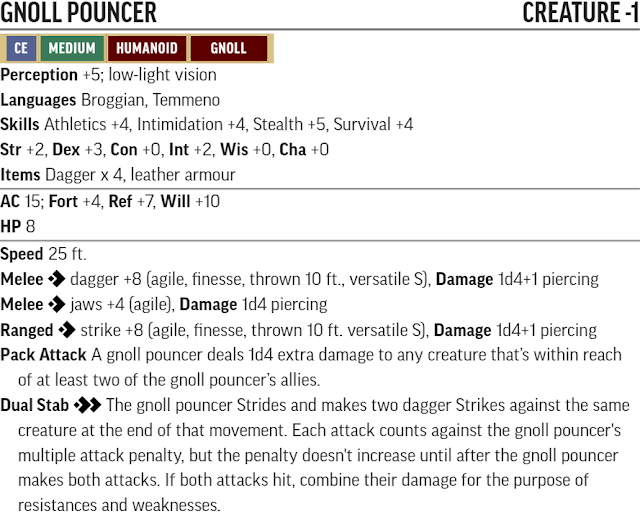
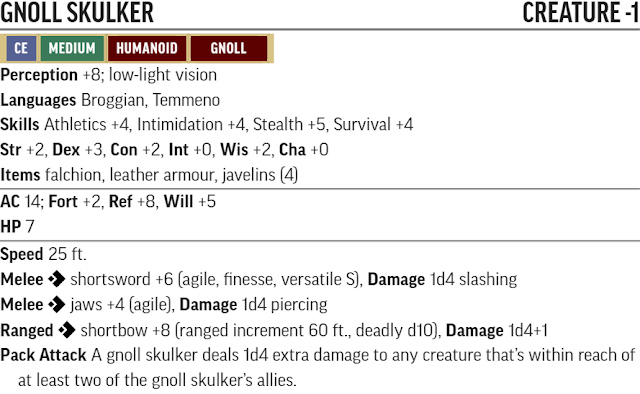
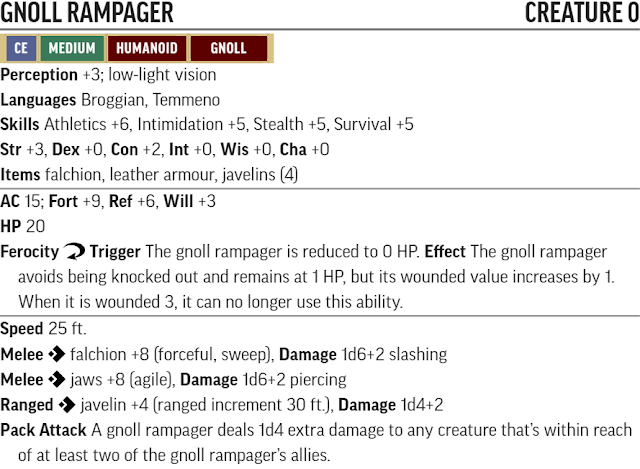
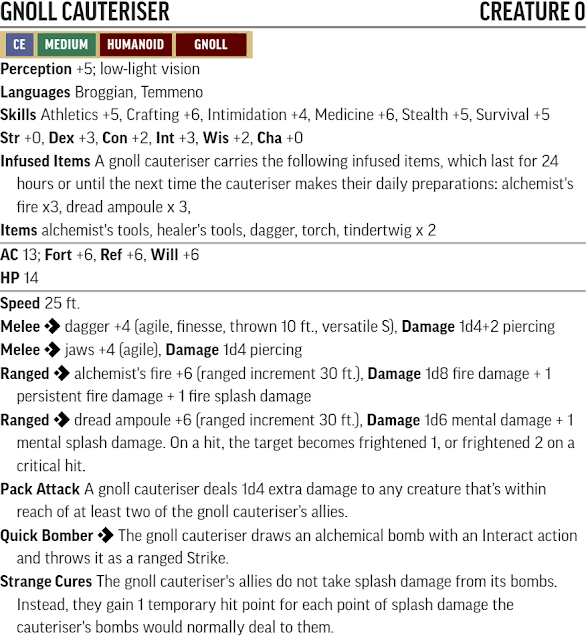
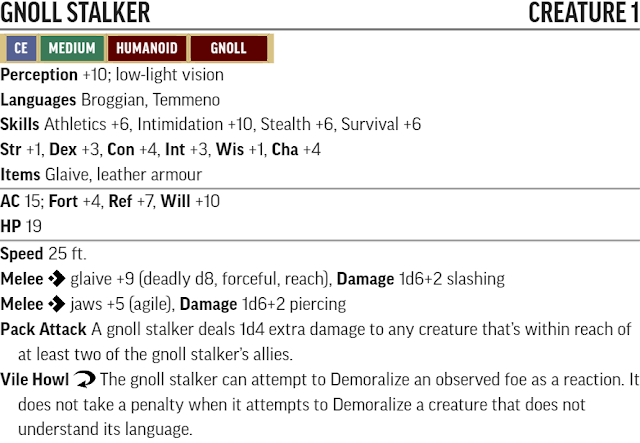
Some Gnoll Opponents for PF 2e

The island of Ursino (not-Corsica) on Verra has a bunch of gnolls. The gnolls are cursed mercenaries who were brought in as exiles from the Temmeno Empire (the not-Ethiopian Empire) over a generation ago by the Banco di Asmodeo to exert the banks control over the island and beat back swarms of the undead. A few missed payments, broken promises, and angry contractual negotiations later, and they're now organised into roving bands threatening the inhabitants of Ursino and are looking for a way off the island to go back home. 

These gnolls are sort of based off of the buda spirit from Ethiopia, tho' only very loosely, and with any anti-semitic elements totally scrubbed. Buda accusations IRL can be used for anti-semitic purposes, but are used more widely to handle breakdowns in social relations. For more see Hagar Solomon's book The Hyena People: Ethiopian Jews in Christian Ethiopia, Tom Boylston's "From sickness to history: evil spirits, memory and responsibility in an Ethiopian market village", and this book chapter about a recent contemporary buda crisis. The part that particularly interests me about budas is their use to express the anxieties of subsistence farmers about integration into the market economy, which is very on-theme with Verra's focus on the 17th century emergence of global capitalism in a fantasy context.

So these gnolls are bad people who have practiced cannibalism and been cursed by the Hidden God to take hyena features for it, one of a larger class of beast peoples originating in this way. They reproduce by spreading the curse - making other people eat dead bodies so that they in turn become gnolls. Ultimately, their goal is not to wipe out the inhabitants of the island or whatever, but to get a few ships and either the crews to operate them or knowledge of how to sail them themselves, and then to go home (where, truthfully, they will be no more welcome; the Temmeno don't want cursed cannibal mercenaries they've already exiled coming back)

There are three gnolls in Pathfinder 2e as it exists: one level 2, one level 3, and one level 4. I wanted PCs to be able to fight gnolls right from the start of the game, so I created a bunch of -1, 0, and 1 level gnolls, which will be especially helpful once the PCs hit levels 2-4 and I can send big hordes of the low level ones after them. I created these gnolls using the PF Tools Monster Builder, and I think there are a few typos where I forgot to change gear or names on powers, but the numbers should all be right.

So with that long introduction, here are some low level gnoll opponents for you to use.


Anyhow, enjoy!

Jan 18, 2022

Openquest 3 SRD Released for Free

 There is now a system reference document (SRD) available for Openquest 3rd edition. The SRD is free to download from this link, and will eventually be hosted as a HTML document on the d101 Games website here.

I haven't had time to write an in-depth review of Openquest 3rd edition, but the changes are substantive and wide-ranging from the first two editions, and overall they are positive cointributions to the system. Openquest's 3rd edition keeps its place as one of my two favourite implementations of the Basic Roleplaying system (BRP) alongside Mythras. 

Mythras appeals to the lover of crunch in me, but Openquest is an excellent, rules-light version of BRP that keeps many of the details that appeal to fans of BRP while simplifying and economising many of the rules that newcomers find fiddly. I think it's one of the best introductions to BRP that one can get. If you want a system that does not have levels, classes, or inflating HP, that makes combat feel deadly and exciting, and that sharply distinguishes between how different kinds of magic work, you might find the BRP family, and in particular Openquest, a product that appeals to you.

Along with the SRD, there is a free quickstart scenario and rulebook that contains most of the rules (it leaves out some of the magic systems available in the main rulebook).

Dec 27, 2021

Placing Locations in Hexes

Here's a simple and fast system for placing locations of interest in a single hex on a grid. I am assuming a four hour watch as the basic unit of travel movement. Hexes can be divided into six equilateral triangles, for anyone who didn't know that.

1) Number the six triangles of the hex in clockwise order starting from the top

2) Roll a d6 and a d4

3) The d6 determines which sub-triangle of the hex the location is in. The d4 determines how many hours of travel into that triangle the location is (4 is the centre).

Variant: You could use d4-1 if you prefer fewer things in the centre and more things by the edge.

That's it, that's the whole system. I find it very fast in practice, and you can use a simple notation in your key to track this that looks like:

AA:17 Haunted Castle (1:3) 

where "AA:17" is the hex coordinates and "1:3" is sub-triangle and hours of travel in.

When the PCs search a hex randomly, they either pick one of the six sub-triangles, or the referee can roll a d6 for which sub-triangle they search if they have no preference. I make each search take a single watch.

The speed really helps here with populating a lot of content into hexes.