Sep 4, 2012

[Dawnlands] Your Friends and Neighbours, the Orthocracy

The Orthocracy is a weird place. Here's what its ordinary citizens look like:
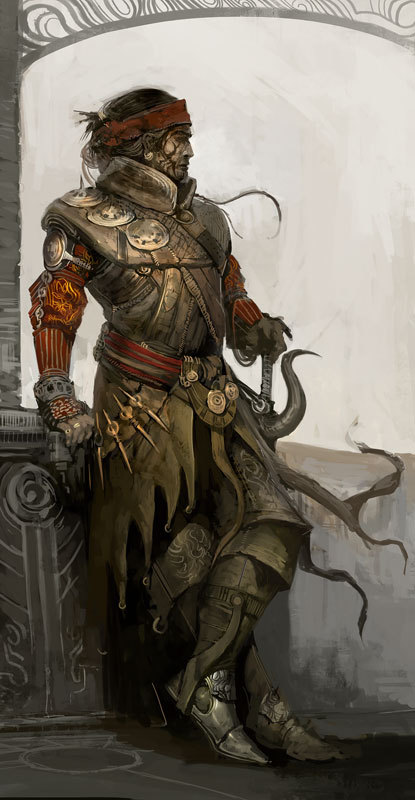
An adventurer

A rich mercenary wearing custom-made plate from Dwer Tor

A katalictor on duty

A priest of Red-Handed Makar, patron of war and agriculture

Upper-middle class formal wear

A soldier of the Orthocracy

Recent fashion trends in the Orthocracy are to obscure the face with veils, masks, facial hair and tattoos

A soldier in the field

A mamluk of the Black Vermin Gods

Women in the Orthocracy need to be as capable with a weapon as any man.

A Weykulnic mercenary in the Cattle Market

An orthocrat's bodyguard 

An adventurer-assassin

Mamluk of the Wives of Dukar.

A veteran of the armed forces on deployment

The uniform of the king's bodyguard, rarely seen since the revolution; worn by counter-revolutionary factions

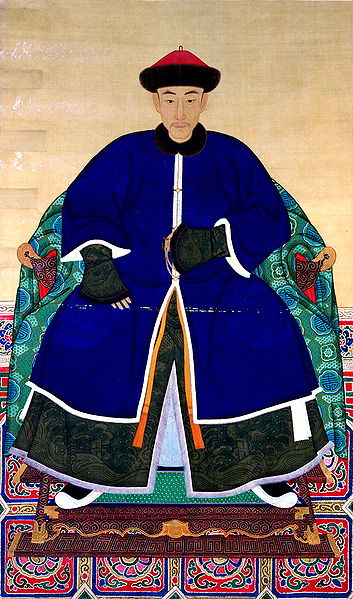
The uniform of a magistrate prior to the revolution. Still worn by country gentlemen as formal wear.

Priests of the Screaming God

Ordinary townspeople

Prosperous horse-traders from the hinterlands of the Orthocracy

The typical clothing of a rural peasant

A gnostic of the Halls of Nightmare in meditation

Miners from the hinterlands near Weykuln

The local council of a village in the hinterlands

A rural woman

Rural dress has changed little since prior to the revolution

The Orthocracy is the epicentre of textile production in the Dawnlands. Its fabrics are in high demand.

A rural family on a stroll


A counter-revolutionary partisan from the hinterlands.

A skilled artisan in his business clothes.
Cassius, high priest of the Red and Blue Snake Cult
A priest of the Black Vermin Gods

Bodily modification through soul-forging has left a legacy of odd-looking people in the Orthocracy.

Dragonman mamluk of the Red and Blue Snake Cult

A gnostic of the Zulaymna, the premier school of sorcery in the Dawnlands

A member of the upper class who has had herself soul-forged along fashionable lines.

A Burnt assassin.

The Assayers of the Forgetower inspect the latest candidate to become a Soulforger.

An adventurer 

Magic is ubiquitous in the Orthocracy. Many make a living selling charms and potions.

Kaddish is a lawless place, where any taste can find satiation.

Another upper-class woman, this time in formal wear.


All gods are welcome in the Orthocracy, the result of an ancient curse.

When they are not killing one another, the Kaddish are marvelously garrulous and jolly.

Household guards of the Hinam clan.


A priestess of the Blind God

An upper-class Burnt woman.

A vampire-cultist stands guard to prevent a murder-gnome from stealing the soul of this corpse before her master can.

A priestess of the Black Vermin Gods

Mamluk of the cult of Seven-Bladed Sij

A gnostic and her familiar

Cavalry officers like this man tend to come from the hinterland

A member of the College of the Wondrous Murder on patrol in Kingshead.

A member of their rivals, the White Square College.

A Burnt townsman


An acolyte pledges her devotion to the Headless God

People in the Orthocracy can vary considerably from what we consider "human" without seeming unusual. 

An acolyte of the Red and Blue Snake Cult has his vow of obedience consecrated

Zulaith the Patriot, the most powerful gnostic in the Dawnlands

Dragonmen often seek work as mercenaries,bodyguards, and manual labourers

A dragonman who survives long enough eventually grows wings

A dragonman thief

A priestess of Red-Handed Makar

Women are legally equals of men in the Orthocracy, and many take up the adventuring life

House guard of clan Shul


Orthocratic soldiers on deployment in the former kingdom of Weykuln


A priestess of the Headless God

Gnostics from the House of Blood and Bone

A conclave at the Zulaymna

All schools of gnostics that sat out the revolution must wear masks.

An upper-class townswoman's everyday clothing. Black has been gaining in popularity.

Brantha Jurthine Klex, the most famous living artist in the Orthocracy

The Orthocracy is known for its alchemists.

Lower-class townswoman's clothing

A gnostic at work
Conservative woman's clothing, the kind of thing daughters are dressed in by overprotective parents.

A mercenary

A fashionable upper-class gentleman, in this case with facial tattoos rather than a mask.

The mask craze started back when the Black Vermin Gods first rose to prominence. 

The Kaddish textile industry is capable of creating clothes unlike any others in the Dawnlands, with custom tailoring to each individual. Thousands of enslaved halfling toil to bedeck even the poorest man with fine clothing.

A vampire cultist praying

Masking the face is considered an act of patriotism that expresses the unity of all people in the Orthocracy regardless of species. Both men and women do it.

A clan assassin receives his mission

Gnostics rarely travel the plains alone. 

Lacking prisons, the Orthocracy punishes those who break its laws with exile, mutilation and death.

The Burnt are a true-breeding variety of human and elf. Their skin is darkly pigmented, ranging from night blue to deep crimson. Though mostly an underclass, their elites are tastemakers and trend-setters amongst the upper class.


Sep 3, 2012

[Dawnlands] Katalictors

Katalictors are created from deformed, simple and maimed children in the Orthocracy of Kaddish. Any child who survives to the age of seven with such a condition or injury is taken from their guardians and tithed to the Soulforgers. The Soulforgers reshape the child into a katalictor, a pale, inhumanly perfect simulacrum of a human. Katalictors serve as agents, companions, concubines, assassins, and assistants to the Soulforgers, who are themselves forbidden to leave the city. Each katalictor is made by a single Soulforger, which creates minor variations between their appearances, but the pale skin, unusual features, exquisite clothing and air of menace and grace mark them out as a class apart from the regular Kaddish. They are fully conscious and aware, and most are extremely grateful to the Soulforgers 

Katalictors are Competence 4 antagonists. They may receive further modifications than those listed below depending on the importance of their task to the Soulforgers and the experience and trustworthiness of the katalictor in question. Common modifications include fangs, the ability to breathe underwater, a voice that compels obedience hypnotically and a bewitching scent that causes them to be highly sexually attractive. There are three broad kinds of specialties they tend to have, warriors, ambassadors and thinkers.

Warriors have Athletics, Close Combat, Dodge, and Resilience as specialties and are weak on Influence.

Ambassadors have Influence, Perception, Performance and Persistence, as specialties and are weak on Close Combat.

Thinkers have Natural Lore, Perception, Lore (Any One), and Sorcery Casting as specialties, and are weak on Influence. Thinkers typically know 3 sorcery spells.

All katalictors regenerate quickly enough that only attacks that deal major wounds affect them. Otherwise, the blow is ignored.

Katalictors usually have 14 HP.


Aug 31, 2012

Actually Surveying Things: A Short Introduction

The production of maps by PCs in the fictional world is an under-used adventure goal despite its dramatic potential. "Surveyor" is actually one of my favourite PC occupations - I've played four in various eras and settings in my roleplaying career. Surveying is the oldest licensed profession in the world (the Romans issued licenses for it), found in almost all sedentary civilisations, and the basic techniques have been intact for thousands of years. Though aerial photography has allowed better information, a surprising number of the processes involved in field surveying are simply refined versions of ancient ones.

One reason for the under-use of surveying and mapmaking as adventure goals is that most people are not surveyors or cartographers and therefore know little about what goes into producing the information that creates an accurate map. This leaves the process abstracted and therefore uninteresting.

First, watch this video in three parts [1] [2] [3] by the United States Army about how maps are made (circa 1973). This explains the basics of triangulation, using plumb lines, theodolites, chains and tapes, plotting tables etc. There are some references to modern technology (an ancient surveyor would use a dioptra, not a theodolite; obviously planes with cameras don't exist in most fantasy settings) but ancient, medieval and early modern tools include the alidade, groma, astrolabe, clinometers (basically variations on astrolabes in their earliest versions), quadrants, sextants, and of course compasses, rulers, telescopes and measuring rods which gathered similar information to the newer tools.

The basic technique in surveying is determining the distance between three points, known as triangulation. So long as one knows the length of one side of the triangle and the angle of the lines from two of the points to the third, one can calculate the length of the lines and therefore the position of the third point, as well as the area of the triangle, using trigonometry. Most of the tools mentioned above help perform one of the two functions. A chain or tape is used to fix the length of the known side, while tools like dioptras are used to measure the angle of the lines forming the triangle. Because this process relies on sighting the third point, various workarounds exist for where terrain prevent clear sighting (i.e. a forest, intervening mountain, etc.), like the construction of towers. All of this happens in three dimensions, not two, so there are additional calculations to determine the relative heights of the points and how that affects the calculated lengths of the lines.

 A web of interlocking notional triangles is created by surveyors hopping from point to point until the relevant area is covered. A single hexagon can be split into six equilateral triangles, for those hoping to use this with hex maps, though most map hexes are too large to be mapped that simply.

If you want to get an idea of the challenges that crop up while surveying, it's worth reading Mason and Dixon by Thomas Pynchon, which along with being a really great book goes into a lot of detail about how difficult a  surveying project can be logistically. PCs who want to execute surveys will have to frequently split up for extended periods of time with one party tromping around in the woods or up hills to place markers, while others go to set up the sighting equipment. You'll need teams of people to cut down intervening obstacles like trees, some way to signal between the parties so they know when the other team is in place or when the task is completed, maybe a building crew plus a stock of building materials to knock up sighting towers when you need them, someone to build and set markers on the points you locate, etc. Plus money for this crew, and guards to keep order, and handlers for all the baggage, etc. You might even need a mathematician. And don't forget the cartographer, the guy who makes the actual maps.

Part 2 of this will deal with cartography, which is the translation of the data gathered during surveying into maps and related representations.

Aug 28, 2012

Improving Teamwork Rules in Openquest

This post has been edited to incorporate Aash's suggestion in the comments.

Openquest is my favourite game system, but its teamwork rules are shit. All of the problems I laid out here with teamwork in adventure games hold true for it. This isn't its fault - it inherited and simplified a tradition passed down from the Runequest family of games, which all have complicated assistance rules that involve lots of addition and little choice. Openquest at least has the virtue of simplifying the addition.

Our constraints:

1) Openquest's Big Bonus Rule, that tells us bonuses and penalties have to come in blocks of +/- 25%

2) Assistance should not easily of boost the chance of success on tasks over 100%, while still being capable of doing so from time to time.

3) We want to provide lots of choice, rather than lots of math. This means that teamwork must allow different ways of contributing to any particular test, which must be able to be used simultaneously by different PCs based on their individual choices.

4) We want to avoid just having each PC roll their skill individually until one of them succeeds at the task, which makes success on tasks where only one PC succeeding almost certain to succeed, and ones where several PCs need to pass almost impossible to cleanly succeed on.

5) Characters should not need the same skill as the one being tested to assist. When I had a data analyst and a copywriter working with me IRL, both assisted my work (producing and mailing ask letters for a major charity) despite neither having the same skill set or team role as me. 

Proposed Rules:

1) In a teamwork situation, only one character rolls for any particular test ("the lead"). This should be either the person directing the others, or the person most directly responsible for the success or failure of the task for some other reason or the person with the highest skill.

2) Characters other than the lead may choose to assist, to cooperate, to collaborate with the lead, or to sit things out. Players should declare which one their character is doing in an orderly fashion (either by initiative, or progressing around the table or some other satisfactory means). One a player has chosen to assist, collaborate or cooperate, and with who, they must do as they chose until the lead has rolled. Characters sitting things out may not contribute to the teamwork test mechanically.

3) Assistance involves acting according to the direction of the lead, and adds +25% bonus to the skill of the lead. Assistants must have the same skill as the lead at 25% or better. Assistance bonuses are not cumulative, but may be redundant (viz. if two people are attempting to assist, and one is prevented from doing so for some reason, so long as one assistant persists the +25% bonus remains).

4) Collaboration involves one of the characters who is not the lead testing a relevant skill prior to or simultaneous to the lead's test. It is up to the collaborator to explain why the chosen skill is relevant, subject to referee approval. It does not need to be the same skill as the one the lead is testing (but may be). Each collaborator must test a different skill from any other collaborator, so only one may test the same skill as the lead.

A critical success by a collaborator provides a bonus of +50% to the lead's test, a regular success provides a bonus of +25%, a failure provides a penalty of -25%, and a critical failure provides a penalty of -50%. Collaborator bonuses and penalties are cumulative with one another.

5) Cooperation involves one of the characters who is not the lead simultaneously testing the same skill as the lead. Cooperators must have the same skill as the lead at 25% or better. If the lead succeeds, then the roll of whoever got the best result amongst the lead and any cooperators is used. If the lead fails, then the worst result amongst the lead and any cooperators is used.

6) Cooperators and collaborators may have assistants, with the same restrictions as if they were the lead.

7) Collaborators may assist cooperators and vice versa as if the other was a lead.

I think this system satisfies the constraints, and would appreciate feedback on it.